
GeeekPi 2-Pack I2C 1602 LCD
4.6Editor score
I2C interface saves pins
Blue backlight adjustable
Compatible with Arduino
This guide compares the top Arduino LCD Display modules for 2026, evaluating screen types, interfaces, resolution, and compatibility to help makers choose the
Arduino LCD displays are essential components for any electronics project requiring visual feedback. Whether you are building a weather station, a robotic interface, or a smart home dashboard, choosing the right screen ensures your data is clear and readable. This guide explores ten top-rated options available today.
We have carefully compared these displays based on interface type, resolution, build quality, and user ratings. Our analysis focuses on how well each module integrates with common microcontrollers like Arduino, Raspberry Pi, and ESP32. We also consider ease of wiring, software support, and value for money.
Each product listing below highlights key specifications, pros, cons, and real-world performance details. Please note that prices and availability can change frequently on Amazon. Always check the current listing before purchasing to ensure you get the best deal for your specific project needs.
4.6Editor score

4.5Editor score

4.7Editor score
The following table provides a side-by-side comparison of all ten selected LCD modules. It highlights their key specifications to help you quickly identify which display matches your project requirements.




This 3-pack from Hosyond offers a fantastic entry point for makers needing text-based displays. With a solid 4.5 rating, these modules are widely trusted for school electronics and DIY projects. Each unit features a classic 16×02 format ideal for showing sensor data or simple messages.
We may earn a commission when you buy through this link, at no additional cost to you.
The I2C interface significantly reduces wiring complexity compared to parallel LCDs. You only need four connections: VCC, GND, SDA, and SCL. The built-in potentiometer allows precise contrast adjustment without external circuits. The blue backlight ensures readability in various lighting conditions.
While excellent for text, these screens lack the resolution for detailed graphics. They are also limited to character output rather than images. However, for standard readouts like temperature or clock data, they perform reliably and efficiently without consuming many GPIO pins.
If you are building multiple projects or need spares, this 3-pack is highly recommended. It balances cost and performance perfectly for Arduino and Raspberry Pi users. The clear documentation and broad compatibility make it a standout choice for this category.
The I2C protocol reduces pin usage by using a serial bus for data transmission, keeping your breadboard tidy and freeing up ports for other sensors.
A built-in potentiometer on the back lets you fine-tune the display contrast physically, ensuring optimal visibility without software configuration.
We may earn a commission when you buy through this link, at no additional cost to you.
ELEGOO's 0.96 inch OLEDs are perfect for small, high-contrast interfaces. This 3-pack delivers 128×64 graphics per module with self-luminous pixels that glow without a backlight. The fixed yellow and blue zones help organize information logically on the small screen.
We may earn a commission when you buy through this link, at no additional cost to you.
Self-luminous OLED technology means each pixel generates its own light, resulting in deep blacks and vibrant colors. This design also saves power compared to backlight LCDs. The I2C connection keeps wiring minimal, requiring only four wires for operation.
The fixed color zones can be a limitation if you need full-color graphics. Additionally, these screens do not support touch input. For static status panels or simple sensor readouts, however, the clarity and power efficiency make them a superior choice over traditional LCDs.
This pack is ideal for projects needing multiple displays, like a sensor dashboard. The compact form factor fits easily into enclosures. With excellent user ratings and reliable performance, these OLEDs represent the best budget option for modern visual feedback.
Because each pixel lights itself, OLEDs offer infinite contrast ratios, making text sharp and readable even in direct sunlight.
Without a constant backlight, these modules consume significantly less power, which is crucial for battery-powered portable projects.
We may earn a commission when you buy through this link, at no additional cost to you.
The AITRIP 2-inch TFT module is a premium choice for visualizing complex data. With 240×320 resolution and an IPS panel, it offers vibrant 262K colors and wide viewing angles. This makes it suitable for dashboards and handheld devices where appearance matters.
We may earn a commission when you buy through this link, at no additional cost to you.
The ST7789V driver IC ensures fast screen updates and reliable communication via SPI. A bright LED backlight keeps the display visible in dark environments. The module supports both 3.3V and 5V logic, simplifying integration with various microcontrollers.
The SPI interface uses more pins than I2C, which might limit peripheral options on smaller boards. The backlight also draws more power than OLED options. Despite this, the superior image quality and color accuracy justify the trade-offs for premium projects.
If you need stunning graphics and text clarity, this module stands out. It is perfect for custom user interfaces and robotics displays. The high user rating confirms its reliability, making it a top recommendation for advanced makers.
IPS technology ensures colors remain consistent and accurate from any viewing angle, essential for interactive displays.
The SPI protocol allows rapid data transfer, enabling smooth scrolling and dynamic graphics updates without lag.
We may earn a commission when you buy through this link, at no additional cost to you.
This 2.8-inch TFT from ELEGOO adds interactive capabilities to projects. It features a 320×240 resolution with a stylus for resistive touch input. This allows users to navigate menus and interact with sensor data directly on the screen.
We may earn a commission when you buy through this link, at no additional cost to you.
The shield format simplifies wiring by stacking directly onto Arduino UNO headers. A MicroSD slot lets you store images or fonts locally. This is ideal for standalone devices that need to display rich content without external memory.
Resistive touch requires pressure rather than light touch, which might feel less responsive than capacitive screens. The shield also uses parallel interface pins, limiting other components. However, the functionality and ease of use are significant benefits for many builders.
For projects needing interactive elements like buttons or graphs, this is a solid choice. The included tutorial CD helps with setup. It offers a balanced mix of features and price for those ready to explore beyond simple displays.
The SD card slot allows storing large image files or font libraries directly on the display unit.
Stackable headers mean no breadboard wiring is needed, saving time during prototyping and testing phases.
We may earn a commission when you buy through this link, at no additional cost to you.
GeeekPi offers a reliable 2-pack of I2C LCD modules perfect for IoT deployments. The I2C protocol reduces wiring and pin usage, leaving more resources for sensors. The blue backlight ensures text remains readable in standard office lighting.
We may earn a commission when you buy through this link, at no additional cost to you.
Each module has a potentiometer for manual contrast adjustment. This physical control allows quick tuning for different environments. The compact dimensions make it easy to install in tight enclosures without obstructing other components.
While limited to text output, these modules excel at showing numerical data and status messages. The lack of graphics support is a trade-off for lower cost and simpler code. For basic monitoring tasks, they provide consistent and reliable performance.
If you need to track temperature or network status, these are excellent. The 2-pack ensures you have a spare for future needs. With strong ratings and straightforward functionality, they fit well into the smart home and IoT categories.
Using I2C means only two data lines are needed, drastically reducing cable clutter on your prototype board.
A small screwdriver allows you to physically adjust the potentiometer for optimal visibility in any light.
We may earn a commission when you buy through this link, at no additional cost to you.
Freenove's 2-pack focuses on ease of use with new integrated circuits. These modules save ports through the I2C interface. The integrated conversion circuit enhances stability during data transmission compared to older separate converter designs.
We may earn a commission when you buy through this link, at no additional cost to you.
Example projects and code are provided via a link on the box. This helps beginners quickly get started without searching online. The package includes modules for mainstream controllers like Arduino and Raspberry Pi Pico.
The lack of a physical tutorial might be inconvenient if you prefer printed instructions. However, the online resources are usually up-to-date. The performance is solid for standard character output, and the integrated design reduces failure points.
For those who want a quick start with good documentation, this is a strong option. The technical support team adds value for troubleshooting. It is a practical choice for hobbyists needing reliable text display modules.
The new design integrates the I2C converter on board, reducing potential connection failures during operation.
Access to example code helps verify setup immediately and understand basic library usage quickly.
We may earn a commission when you buy through this link, at no additional cost to you.
SunFounder provides a module with excellent library support for quick coding. The IIC protocol simplifies connections to just four wires. This reduces wiring errors and makes prototyping faster for beginners and experts alike.
We may earn a commission when you buy through this link, at no additional cost to you.
A dedicated library allows direct calls without writing low-level drivers. This saves development time significantly. The potentiometer helps adjust contrast manually for better reading conditions. The module is compatible with standard Arduino boards.
The lack of digital backlight intensity control means you cannot automate brightness changes. The standard size might not fit very tight spaces. For basic projects, however, the ease of setup is a major benefit that often outweighs these limits.
If you want to minimize coding time and maximize hardware simplicity, this is a great pick. It works well for sensor monitoring tasks. The high user rating confirms its reliability and ease of use in general projects.
The provided library lets you start displaying text immediately with just a few lines of code.
Clear labeling on the module prevents wiring mistakes, making setup faster and more straightforward.
We may earn a commission when you buy through this link, at no additional cost to you.
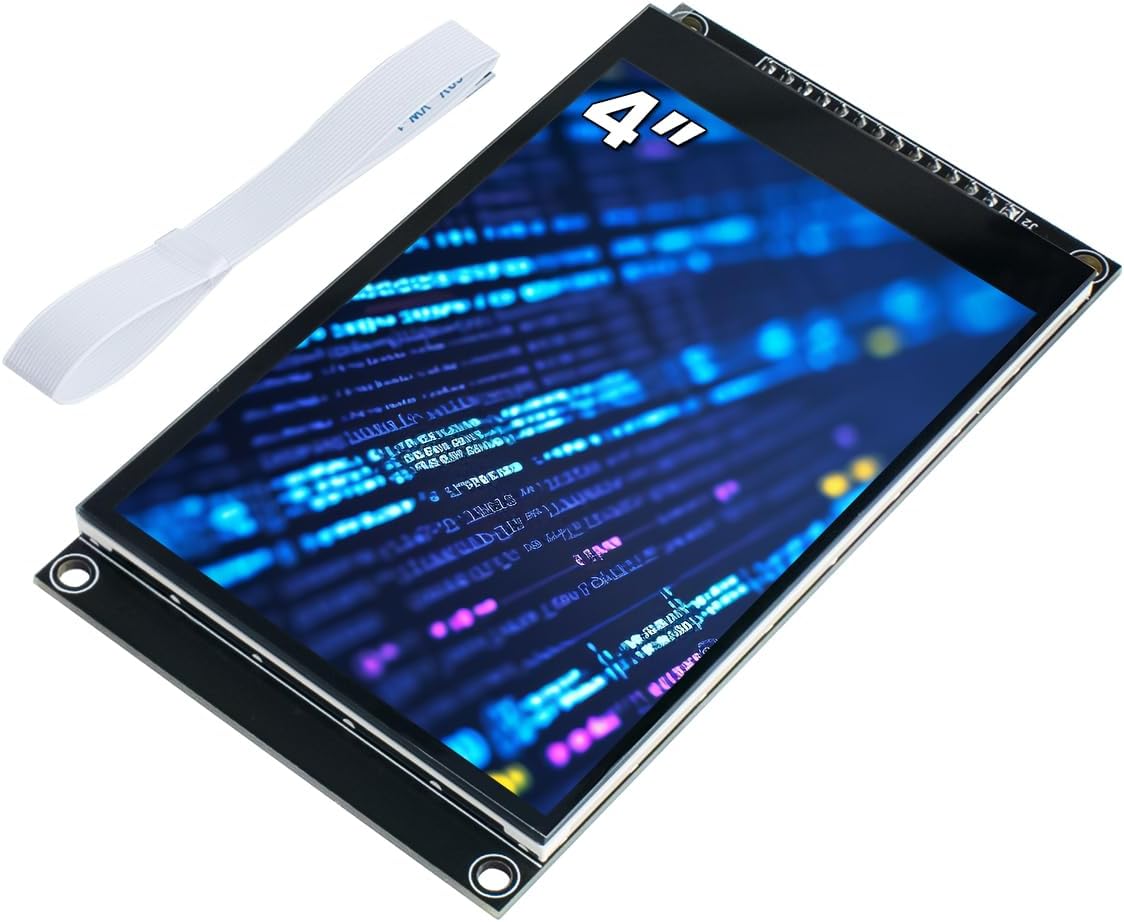
Hosyond's 4.0-inch module offers a large area for complex visuals. It supports capacitive touch, which is more accurate than resistive options. The resolution allows for detailed charts and images in your projects.
We may earn a commission when you buy through this link, at no additional cost to you.
The driver ensures level conversion for both 3.3V and 5V. This makes it versatile for different Arduino boards. The SPI interface saves I/O pins. A TF card slot supports storage expansion for assets.
Power consumption is higher than smaller displays due to screen size. The wiring is more complex. However, for robotics dashboards or control panels where user interaction is critical, these benefits are substantial.
This module is best for advanced projects needing large screens. The capacitive touch adds a modern feel. With a range of supported MCUs, it fits well into diverse application scenarios.
Capacitive touch allows for multi-touch gestures and faster input response compared to older resistive screens.
The TF card slot lets you store media files locally, reducing reliance on external flash memory.
We may earn a commission when you buy through this link, at no additional cost to you.
This 5-pack from Hosyond offers excellent value for bulk needs. Each 0.96 inch OLED provides crisp text with 128×64 resolution. The self-luminous nature ensures high contrast even in dark settings.
We may earn a commission when you buy through this link, at no additional cost to you.
The SSD1306 driver ensures reliable communication. Power consumption is low at 0.04W during normal operation. This makes them suitable for battery projects. The pack includes both blue and yellow panels for visual variety.
The screens are small, limiting them to basic readouts. They do not support touch input. For large-scale deployments where cost is a factor, this pack is hard to beat. The quality remains consistent across units.
If you need multiple displays for sensor stations, this is ideal. The low power draw supports long battery life. With strong user satisfaction, it is a smart buy for large-scale prototypes.
These modules draw minimal power, making them perfect for battery-operated IoT nodes running for extended periods.
The mix of blue and yellow OLEDs helps distinguish between different data streams visually without software changes.
We may earn a commission when you buy through this link, at no additional cost to you.
This 2-inch IPS module is a compact color option. With 240×320 resolution and an IPS panel, it offers 262K colors. This resolution allows for rich graphics in a small footprint.
We may earn a commission when you buy through this link, at no additional cost to you.
It supports both 3.3V and 5V logic. Ensure power consistency to avoid damage. The SPI interface requires minimum GPIO pins. A backlight LED helps in dim lighting.
If power supply is not consistent, the display may not function properly. It is generally reliable. For handheld electronics needing color, this is a good choice.
For portable projects needing clear graphics, this module fits well. The compact size suits handhelds. It offers a balanced mix of display size and color quality.
IPS technology delivers consistent color and wide viewing angles essential for handheld devices viewed from various positions.
Small dimensions make this display ideal for handheld or wearable electronic projects where space is limited.
We may earn a commission when you buy through this link, at no additional cost to you.
Selecting the right display involves balancing resolution, interface, and power. This section covers key factors to ensure your hardware choice fits your software goals.
I2C saves pins by using just two data lines for communication. SPI offers faster speeds but uses more wires. Parallel interfaces need the most GPIOs but can refresh quickly. Choose I2C for simple text projects and SPI for graphics or animations.
LCDs use a backlight and are better for text. OLEDs are self-luminous with better contrast but cost more. LCDs are generally more power-hungry due to the backlight. For battery projects, consider OLEDs for efficiency.
Resolution determines how much data you can show at once. Larger sizes help with complex data but consume more power. Ensure the dimensions fit your enclosure. Check pixel density for readability at a distance.
Modules often support 3.3V or 5V. Ensure your microcontroller logic matches the display voltage. Incompatible levels can damage the screen. Check for built-in level converters to avoid extra components on your circuit.
Touch screens add interactivity to projects. Capacitive touch is more responsive than resistive. Resistive screens work with any stylus but require pressure. Choose based on user interaction needs.
Popular drivers like SSD1306 and ST7789V have extensive code libraries. This reduces development time significantly. Check for community support before buying. Well-documented drivers make coding easier.
IPS displays offer better viewing angles than standard TN panels. Backlight is crucial for visibility in low light. Consider the ambient light in your final location.
Buying packs saves money if you need multiple units. Ensure packaging includes cables or adapters. Check what is included in the box to avoid buying extra connectors.
Start by wiring the power and ground correctly. Match your microcontroller voltage to the display. Double-check connections before applying power to avoid shorts. Ensure SDA and SCL are connected for I2C modules.
Install the necessary drivers and libraries via your IDE. Verify the I2C address using a scanner tool if needed. Adjust the contrast potentiometer for clear visibility. Test basic text output before adding complex graphics.
Keep the screen clean with a soft dry cloth. Avoid excessive pressure on OLED panels. Store in dry conditions to prevent moisture damage. Regular checks ensure longevity in your projects.
I2C LCDs use only two pins for data, saving space. Parallel displays use many pins for faster refresh rates. I2C is better for beginners and compact projects. Parallel is for complex graphics.
Check your power supply and connections first. Ensure your code matches the driver IC. Verify voltage levels. Adjust contrast or check address settings in your code.
Yes, if they have different addresses. Some modules come with address jumpers. If not, you may need a multiplexer to share the bus. Ensure your code handles unique device IDs.
For simple sensor data, 16×02 character displays are sufficient. They consume less memory and power than pixel screens. For richer visuals, choose 128×64 or higher resolution screens.
OLEDs have higher contrast and faster response times. They consume less power when displaying dark images. However, they can be more expensive. LCDs are still better for long static displays.
Open the IDE Library Manager and search for the driver. Install the package. Include the library header file in your code. Check examples in the library menu for guidance.
This often indicates power or connection issues. Ensure wiring matches the schematic. Check voltage levels. Update your library if it is outdated. Adjust contrast settings if needed.
Most modules last for thousands of hours of use. OLEDs may degrade over time if static. Keep brightness moderate. Regularly check connections to prevent hardware issues.
The Arduino LCD displays listed above offer a wide range of options. From simple text to rich graphics, there is a module for every project. The top picks balance cost and performance effectively for most users.
Prioritize the interface and power requirements based on your design. I2C modules save pins while OLEDs save power. Select the resolution that matches your visual goals without overcomplicating the hardware setup.
Always verify current prices and availability before ordering. Product specs may change over time. Check the latest product descriptions to ensure compatibility with your specific microcontroller model.