
ADS1115 2Pcs Pack
5.0Editor score
Affordable two pack deal
Programmable gain amplifier
Wide voltage supply range
This guide compares the top ten Arduino ADC boards including ADS1115 and ADS1256 modules for high precision data acquisition and sensor integration projects.
Finding the right analog to digital converter for your microcontroller projects can be challenging. You need precise measurements without complex wiring or excessive cost. This guide explores the best options available for Arduino users.
We have analyzed technical specifications, user feedback, and real world performance to compile this list. Each board offers unique advantages for different sensor types and application needs. Our comparison focuses on accuracy, ease of use, and reliability.
Every recommendation includes detailed pros and cons to help you decide quickly. Prices fluctuate regularly so always check current listings before purchasing. We updated this guide in November 2026 to reflect the latest market offerings.
5.0Editor score

4.7Editor score

4.6Editor score
The following table provides a side by side overview of every selected ADC board. We highlight key specifications to help you compare resolution, channel count, and interface types at a glance.




This ADS1115 module stands out as the top choice for most Arduino projects. It delivers reliable 16-bit resolution across four channels with an I2C interface that simplifies wiring significantly.
We may earn a commission when you buy through this link, at no additional cost to you.
The included programmable gain amplifier allows you to measure small signals with high accuracy. Users report excellent stability when reading thermocouples or strain gauges over long periods.
While it lacks the speed of some SPI based alternatives, the data rate is sufficient for most sensor applications. The auto shutdown feature helps reduce power consumption in battery powered setups.
If you need a versatile and easy to use ADC board, this pack offers exceptional value. It is ideal for students and hobbyists building data loggers or monitoring systems.
The 16-bit resolution ensures you capture minute voltage changes that other converters might miss.
Single-shot mode automatically powers down the chip between readings to save energy.
We may earn a commission when you buy through this link, at no additional cost to you.
For applications demanding extreme precision the ADS1256 is a powerful option. Its 24-bit resolution captures voltage changes that standard 16-bit boards simply cannot detect.
We may earn a commission when you buy through this link, at no additional cost to you.
The onboard reference voltage source ensures consistent measurements without needing external components. This makes it suitable for laboratory grade data acquisition tasks.
Wiring is more involved due to SPI communication and additional control lines. You will also need to write more sophisticated code to handle the data buffering properly.
Choose this board when accuracy matters more than simplicity or cost. It excels in scientific instruments and professional sensor calibration projects.
24-bit depth allows detection of microvolt level changes in analog signals.
Four differential pairs reduce noise by measuring voltage differences directly.
We may earn a commission when you buy through this link, at no additional cost to you.
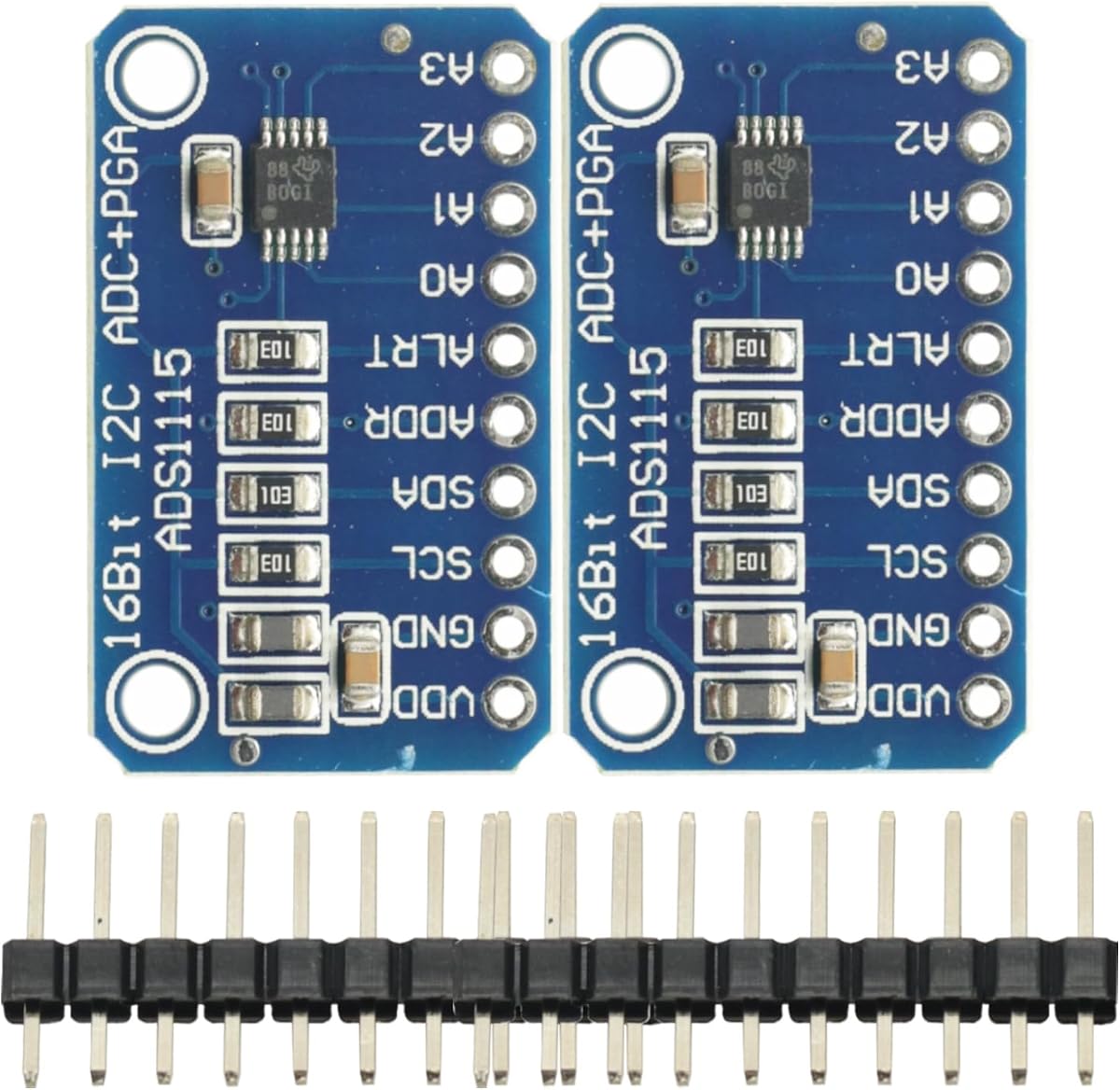
This two pack delivers exceptional value for makers on a tight budget. You get two fully functional ADS1115 modules for a fraction of the cost of single units.
We may earn a commission when you buy through this link, at no additional cost to you.
The programmable gain amplifier lets you optimize sensitivity for different sensor types. Users find it perfect for classroom labs or multiple node projects.
While the packaging is minimal the board quality matches more expensive brands. The I2C address pins allow you to connect both modules to one bus easily.
If you are building several projects simultaneously this pack prevents supply shortages. It is the smartest choice for students or large scale deployments.
Buying in packs reduces per unit cost significantly for bulk projects.
Selectable I2C addresses let you daisy chain multiple units on one bus.
We may earn a commission when you buy through this link, at no additional cost to you.
HiLetgo is a trusted name in development boards and this pack reflects their quality. You receive three ADS1115 modules ready for immediate integration into your designs.
We may earn a commission when you buy through this link, at no additional cost to you.
The comparator mode adds flexibility for threshold triggering without constant polling. This reduces microcontroller load in monitoring applications significantly.
Auto shutdown helps maintain accuracy by reducing heat generation during idle times. It is especially useful for battery powered portable devices.
This pack suits those who need spares for classroom use or backup stock. The consistent quality ensures reliable performance across all three units.
Triggers interrupts when input crosses thresholds instead of continuous polling.
Operates from 2.0V to 5.5V to match various logic levels.
We may earn a commission when you buy through this link, at no additional cost to you.
This four pack is designed for workshops needing multiple units at once. It reduces the risk of running out mid project when students or team members need spares.
We may earn a commission when you buy through this link, at no additional cost to you.
The internal oscillator removes the need for external crystals simplifying the design. Differential inputs allow noise rejection in electrically noisy environments.
Quality can vary slightly between units so testing before bulk deployment is wise. Most work perfectly but some may need minor calibration adjustments.
Buy this when you have a team or school program requiring many modules. The savings over individual purchases make it worth the minor risk.
Built-in clock source simplifies board design and reduces component count.
Measures voltage difference between two inputs to cancel common noise.
We may earn a commission when you buy through this link, at no additional cost to you.
With a perfect five star rating this module pack meets user expectations consistently. The seven programmable input ranges make it adaptable to nearly any sensor.
We may earn a commission when you buy through this link, at no additional cost to you.
The programmable gain amplifier boosts small signals for accurate digitization. It integrates smoothly with both Arduino and Raspberry Pi systems.
Users appreciate the straightforward documentation and available code examples online. Setup takes minutes with standard I2C libraries like Adafruit ADS1115.
This pack is ideal for general purpose use where versatility is key. You will rarely need another ADC module after using these.
Seven programmable ranges adapt to signals from millivolts to volts.
Compatible with Arduino Raspberry Pi and other I2C enabled boards.
We may earn a commission when you buy through this link, at no additional cost to you.
Lonely Binary stands out with ENIG plating that resists oxidation and improves soldering. This premium finish ensures long term reliability for permanent installations.
We may earn a commission when you buy through this link, at no additional cost to you.
The pre-soldered headers save time on breadboarding and reduce manual work. You can connect directly with jumper wires right out of the box.
Four modules can chain on one I2C bus providing up to sixteen total channels. This is perfect for multi-sensor arrays in large IoT projects.
Choose this brand if you value build quality and durability over lowest price. It is excellent for educational kits and professional prototypes.
Gold immersion plating prevents corrosion and ensures reliable connections.
Four unique addresses allow chaining multiple modules on one I2C bus.
We may earn a commission when you buy through this link, at no additional cost to you.
The AD7606 offers simultaneous sampling which is rare in hobby grade modules. This ensures all channels capture data at the exact same instant.
We may earn a commission when you buy through this link, at no additional cost to you.
With 200KHz sampling rates it handles fast changing signals like motor currents. The parallel data output speeds up processing on capable microcontrollers.
However the low user rating suggests potential compatibility or documentation issues. Wiring requires careful attention to control signals and voltage levels.
Use this only if your project specifically needs synchronized high speed data. For most users standard ADS1115 modules will suffice.
All channels convert at once for accurate multi-phase signal analysis.
200KHz rate captures fast transients without aliasing effects.
We may earn a commission when you buy through this link, at no additional cost to you.
This four pack offers a strong balance of quantity and quality. The solid rating indicates consistent performance across the batch.
We may earn a commission when you buy through this link, at no additional cost to you.
Integration is straightforward with standard I2C libraries available for ESP32 and Arduino. It supports a wide range of sensors from temperature to pressure.
The packaging is basic so handle modules carefully during unpacking. Documentation relies on general ADS1115 datasheets found online.
It is a practical choice for expanding existing sensor networks. The price per unit makes it efficient for large deployments.
Works seamlessly with ESP32 built-in I2C peripherals.
Adapts to analog output sensors without needing extra circuitry.
We may earn a commission when you buy through this link, at no additional cost to you.
The single unit option is perfect for quick experiments or replacements. HiLetgo reputation ensures reliable quality without needing to buy multiples.
We may earn a commission when you buy through this link, at no additional cost to you.
Comparator mode allows hardware level triggering reducing CPU overhead. This is useful for alarm systems where response time matters.
You pay slightly more per module compared to packs but gain flexibility. It is easy to test before committing to larger orders.
Use this when you need one reliable ADC board immediately. It is the safest choice for single project needs.
Buy just one module if you only need a single channel solution.
Comparator mode enables interrupts without constant software polling.
We may earn a commission when you buy through this link, at no additional cost to you.
Selecting the right ADC board depends on your specific project requirements. We outline key factors to consider before making your decision.
Higher bit resolution allows you to detect smaller changes in analog signals. For most general purpose sensors 16-bit is sufficient but scientific instruments may need 24-bit.
Prioritize higher resolution when measuring tiny voltage changes from strain gauges or thermocouples.
The number of channels determines how many sensors you can connect simultaneously. Some boards offer eight channels while others limit you to four.
Choose a board with enough channels to cover all your sensor inputs without multiplexing.
I2C interfaces use only two pins but are slower than SPI which can transmit more data quickly. Consider how fast your application needs to sample data.
Use I2C for simple sensor reading and SPI for high speed data acquisition tasks.
A PGA allows you to amplify small signals before conversion improving accuracy. This is crucial when working with sensors that output millivolt level signals.
Always look for a board with PGA support if you plan to use sensitive sensors.
Ensure the board operates within your microcontroller voltage range. Many boards support both 3.3V and 5V logic levels.
Check the supply range to avoid compatibility issues with your specific Arduino model.
Differential inputs measure voltage difference between two pins rejecting common noise. This improves accuracy in electrically noisy environments.
Select boards with differential channels if your sensors share a noisy power source.
The sample rate indicates how many readings per second the ADC can perform. Fast moving signals need higher rates to avoid missing data.
Ensure the sample rate matches the dynamics of the physical phenomena you are measuring.
Buying in packs reduces cost and ensures you have spares for future projects. Single units are better for testing or minimal setups.
Buy in packs if you need multiple units for team projects or bulk applications.
Connect the power and ground pins to your microcontroller first before attaching signal lines. Use the included headers or solder your own for secure connections.
Install the recommended library for your board in the Arduino IDE. Verify pin definitions match your wiring to prevent communication errors.
Store unused modules in anti-static bags to protect sensitive components from damage. Clean exposed pins regularly to maintain good electrical contact.
Most modern ADC boards have built-in voltage regulators that handle different input levels. Check the datasheet to see if your specific model requires external components.
Yes you can daisy chain multiple boards using different I2C addresses. Ensure your microcontroller supports enough addresses for all devices.
Single-ended measures voltage relative to ground while differential measures voltage difference between two pins. Differential inputs reduce noise interference in noisy environments.
Multiply the ADC value by the reference voltage and divide by the maximum ADC value. This formula converts digital counts back to real world voltage.
Fluctuations often come from electrical noise or unstable reference voltages. Use proper grounding and bypass capacitors to stabilize readings.
Most I2C ADC boards work with ESP32 since it includes built-in I2C support. Ensure the voltage logic levels match between the board and ESP32.
Calibration frequency depends on environmental conditions and required accuracy. For high precision work calibrate every few months or when temperature changes significantly.
Analog output sensors like thermocouples, photoresistors, and accelerometers work well. Ensure the sensor output voltage matches the ADC input range.
We recommend the Teyleten Robot ADS1115 for most users due to its balance of features and value. For budget conscious projects the 2Pcs ADS1115 pack offers incredible savings.
Prioritize resolution and channel count based on your sensor needs rather than just price. High speed applications may require the specialized AD7606 module for accurate data.
Always verify current availability and shipping times before placing your order. Prices and stock fluctuate regularly so check details at the time of purchase.