
OWON DGE2035
4.2Editor score
35MHz function generator
125MSa/s sampling rate
PC control via USB
Discover the top 10 Amfm Signal Generator options for 2026. We compare features, performance, and reliability to help you find the right tool.
Selecting the right Amfm Signal Generator is crucial for electronics testing and radio frequency applications. These devices create precise waveforms needed for calibration, research, and maintenance tasks across various industries.
We evaluated ten leading models based on frequency range, modulation types, output stability, and user interface design. Our analysis considers both professional-grade specifications and accessibility for hobbyists seeking reliable performance.
Each selection highlights unique capabilities from portable handheld units to advanced dual-channel systems. Keep in mind that pricing and availability may fluctuate, so verify current details before making your final purchase decision.
4.2Editor score

5.0Editor score

5.0Editor score
This side-by-side comparison highlights key specifications across all ten models to help you identify the device that best fits your specific testing requirements and budget constraints.




The UNI-T UTG962E stands out as the premier choice for professionals needing reliable RF testing capabilities. With a perfect five-star rating, this unit delivers exceptional performance across its 60MHz range.
We may earn a commission when you buy through this link, at no additional cost to you.
Its dual-channel architecture supports sine, square, and arbitrary waveforms with 200 MS/s sampling. The inclusion of AM, FM, and PM modulation makes it versatile for diverse communication testing scenarios.
While the cost reflects its premium build quality, the compact palm-sized design ensures portability without sacrificing power. Users appreciate the ease of storing non-volatile waveforms for quick recall during field work.
Ideal for electronics enthusiasts and engineers alike, this generator balances cost-effectiveness with high performance. It is the definitive recommendation for those requiring a robust handheld solution.
With 200 MS/s sample rate and 1μHz resolution, this unit ensures detailed signal analysis.
USB connectivity allows for easy data transfer and remote control options.
We may earn a commission when you buy through this link, at no additional cost to you.
The OWON DGE2035 offers an excellent entry point for users needing dual-channel functionality without a high price tag. It supports 35MHz output with solid stability for general lab testing needs.
We may earn a commission when you buy through this link, at no additional cost to you.
Its 14-bit resolution provides clean signals suitable for education and industrial verification. The color TFT LCD displays real-time settings clearly, making adjustments intuitive even for beginners.
PC control via USB expands its utility for automated testing routines. While it lacks the upper frequency range of premium models, it delivers reliable performance for its specified capabilities.
This unit is perfect for research labs and educational training where budget constraints are key. It ensures students and technicians gain experience with professional-grade waveform generation.
Ideal for university labs due to its ease of use and standard waveform library.
USB control facilitates integration into larger testing setups efficiently.
We may earn a commission when you buy through this link, at no additional cost to you.
The SEESII Dual Channel Signal Generator is a powerhouse for advanced circuit testing. It earns a perfect rating due to its independent dual channels capable of synchronized or differential outputs.
We may earn a commission when you buy through this link, at no additional cost to you.
With a 266MSa/s sampling rate and 14-bit resolution, signal integrity remains top-tier even at 30MHz. The 7-in-1 integration reduces clutter by combining frequency meter and sweeper functions.
Users benefit from 60 built-in arbitrary waveforms, enhancing simulation capabilities significantly. Pulse width adjustability allows for precise timing simulations critical in digital logic debugging.
Engineering R&D and factory inspection teams will find this unit indispensable. Its complete package means you can start testing immediately without purchasing additional cables or adapters.
Fully independent parameter adjustment ensures accurate multi-channel circuit verification.
Combining multiple tools saves desktop space and reduces equipment investment.
We may earn a commission when you buy through this link, at no additional cost to you.
This 6-Band Signal Generator focuses on durability and simplicity for maintenance tasks. It covers a useful range up to 150MHz, making it suitable for radio testing equipment maintenance.
We may earn a commission when you buy through this link, at no additional cost to you.
Low phase noise characteristics ensure signal purity which is vital for high requirement environments. The front panel layout is logical, allowing technicians to adjust parameters quickly without confusion.
Constructed with high-class metal and resistant plastic, it withstands industrial wear and tear. The one-piece structure means no assembly is required, saving valuable setup time.
Ideal for field service and lab maintenance, this unit offers flexibility without digital complexity. It is a robust choice for users prioritizing longevity over advanced programmable features.
Scratch-resistant and impact-resistant materials ensure long-term reliability in harsh conditions.
Low phase noise reduces interference errors during sensitive testing procedures.
We may earn a commission when you buy through this link, at no additional cost to you.
The Upgraded RF Signal Generator offers unmatched range from 35MHz up to 4400MHz. This broad coverage supports applications spanning from traditional RF up to microwave frequencies.
We may earn a commission when you buy through this link, at no additional cost to you.
It supports single frequency and sweep modes to help users analyze signal response across bands. The memory function saves settings so you resume work exactly where you left off.
Powered by a mobile charger or computer USB, it is exceptionally convenient for mobile technicians. The noise wave output is noted as limited to sine wave primarily.
Suitable for variety of applications requiring wide coverage without bench power dependency. It serves well for quick diagnostics where extreme range is the primary requirement.
Accessing frequencies up to 4.4GHz allows testing of modern wireless communication systems.
USB power support enables testing directly in the field without heavy batteries.
We may earn a commission when you buy through this link, at no additional cost to you.
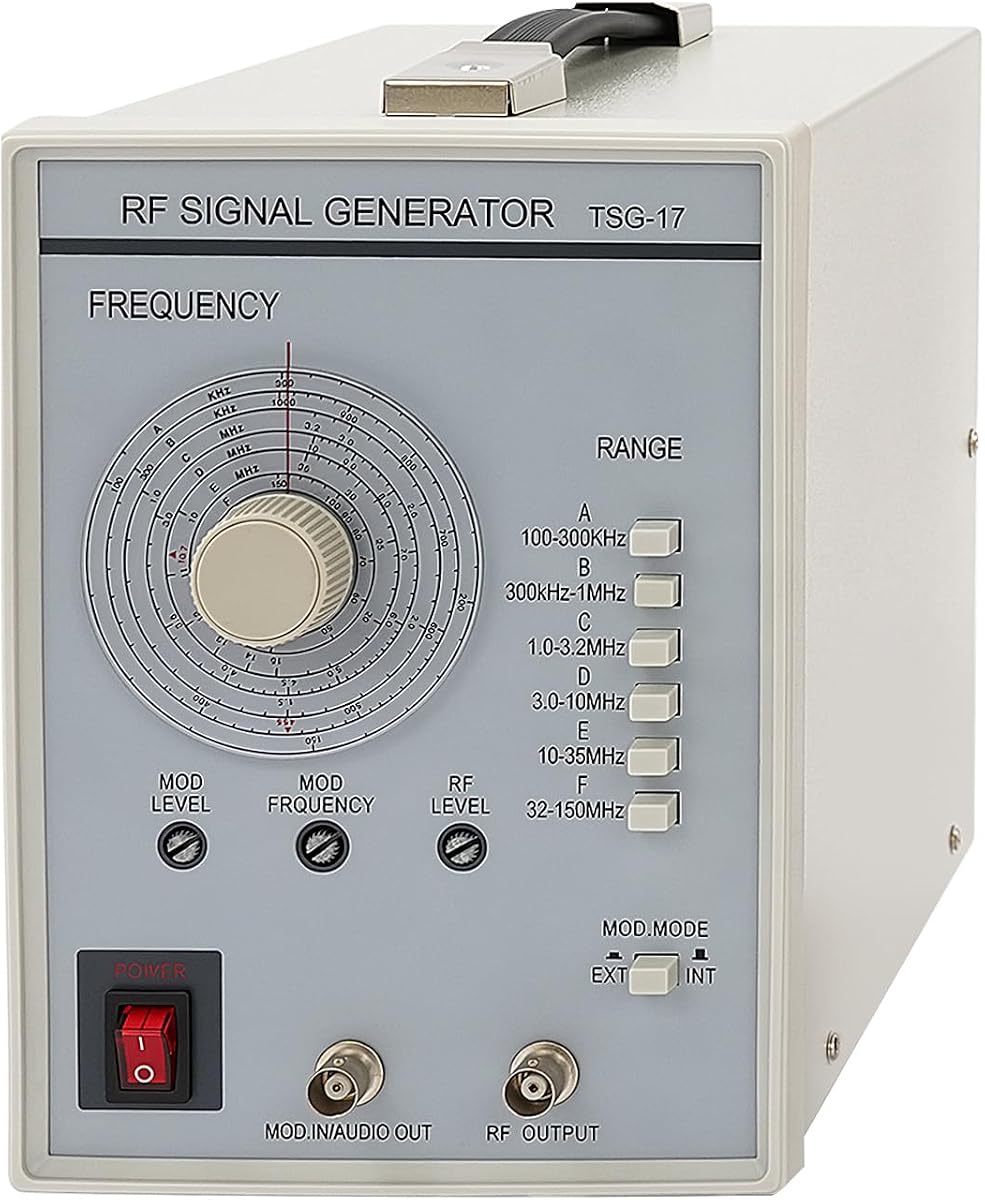
The TSG-17 Signal Generator provides a focused solution for high frequency and AM radio testing. It covers up to 150MHz with harmonics reaching up to 450MHz for broader testing.
We may earn a commission when you buy through this link, at no additional cost to you.
Output control ranges from 1mV to 100m, allowing precise adjustment for sensitive circuits. External modulation signals can be set between 50Hz to 20 KHz for advanced experiments.
While its rating is lower than digital models, it meets standard commercial needs well. It is designed for household or commercial applications where basic signal generation is required.
Best suited for users needing a simple RF source without complex digital menus. It ensures high accuracy for standard frequency checks and maintenance tasks.
3 harmonic up to 450MHz extends utility beyond the fundamental frequency.
External modulation input allows integration with other test equipment easily.
We may earn a commission when you buy through this link, at no additional cost to you.
This Adjustable Signal Generator focuses on industrial loop testing with 4-20mA and voltage outputs. It is designed for simulating sensor signals in PLC and panel debugging environments.
We may earn a commission when you buy through this link, at no additional cost to you.
With a built-in 1500mAh battery, it offers 1-5 hours of runtime for field work. The voltage and current outputs are calibrated for accuracy after setup.
PWM output adds versatility for testing switching circuits up to 150 kHz. Short circuit and reverse connection protection ensure safe operation even if wiring errors occur.
Ideal for maintenance technicians verifying sensor loops without needing a bulky power source. Its portability makes it a reliable tool for troubleshooting industrial equipment.
Simulating 4-20mA loops helps verify control systems without real sensors.
Built-in protections prevent damage to both the unit and connected devices.
We may earn a commission when you buy through this link, at no additional cost to you.
The Riiai 0-10V generator is optimized for precision voltage and current simulation. It is highly rated for its fast encoder knob that allows quick adjustments with high resolution.
We may earn a commission when you buy through this link, at no additional cost to you.
Four different digit displays support voltage, current, percent, and frequency views. This versatility helps in debugging flow valves, servo motors, and light dimmers easily.
With a 1000mAh battery and multiple power options, it adapts to any work environment. Short circuit and reverse connection protection make it safe for repeated use.
Best for technicians needing a portable and precise tool for industrial panels. It ensures quick validation of sensor inputs and control system outputs.
The encoder knob allows rapid value changes for efficient testing cycles.
Switching display modes helps visualize data in the most relevant format.
We may earn a commission when you buy through this link, at no additional cost to you.
The Riiai SG003A provides versatile signal conversion with a vivid 2.4 inch TFT display. It supports multiple signal types including mA, V, and Hz for broad testing needs.
We may earn a commission when you buy through this link, at no additional cost to you.
The real-time curve display helps visualize how values change over time which aids diagnostics. With a 3000mAh battery, it offers up to 26 hours of working time.
Automatic modes like monotonous rise or fall enable automated ramp testing easily. This reduces manual input requirements during long verification procedures.
Ideal for complex industrial debugging where visualization and battery life are critical. It combines advanced features with user-friendly interface for daily maintenance tasks.
Curve display allows seeing trends rather than just static numbers instantly.
Large battery supports extended field testing without frequent recharging.
We may earn a commission when you buy through this link, at no additional cost to you.
The DROK 4-20mA Generator is a multifunctional kit designed for simple signal simulation. It combines ampere and voltage generation into one module for easy handling.
We may earn a commission when you buy through this link, at no additional cost to you.
A multi-cycle precise potentiometer allows smooth adjustments of current and voltage levels. This simplicity is ideal for quick testing of value adjusting and LED panels.
Its compact design makes it easy to store and carry for on-the-spot checks. The straightforward interface minimizes learning curves for new users.
Best for basic PLC panel testing where advanced features are unnecessary. It offers a reliable and economical solution for standard industrial calibration.
Single potentiometer control ensures intuitive operation for basic tasks.
Small footprint allows integration into tight workspaces easily.
We may earn a commission when you buy through this link, at no additional cost to you.
Selecting the right Amfm Signal Generator requires evaluating your specific frequency needs, waveform types, and portability requirements to ensure optimal performance.
Determine the maximum frequency you need for your applications. Some models cover up to 4400MHz for RF work while others focus on lower precision ranges.
Select a range that exceeds your highest requirement to allow for headroom in testing.
Check if the generator supports AM, FM, PM, or FSK modulation. These are essential for communication system testing and signal analysis.
Ensure the specific modulation types match the standards of the equipment you are testing.
Dual-channel generators allow simultaneous output of different signals for differential testing. Single-channel units are simpler but limit complex circuit debugging.
Choose dual channels if you need to compare or phase-synchronize two signals.
Low phase noise and high resolution ensure the signals are clean and accurate. This is critical for sensitive radio testing and lab environments.
Look for high sampling rates and bit resolution to minimize distortion.
Handheld units with batteries are great for field work but may sacrifice power. Benchtop units offer more features but are less mobile.
Consider your primary workspace to decide between portability and performance.
USB interfaces enable PC control which is useful for automation. Physical knobs and buttons allow quick adjustments during manual testing.
Opt for hybrid models that offer both digital control and tactile interface.
Sturdy materials protect the device against drops and industrial environments. Metal casings provide better heat dissipation than plastic ones.
Invest in a durable build if you plan to use the unit in harsh conditions.
Budget units provide basic functions but may lack precision or warranty support. Premium models offer advanced features that save time in the long run.
Balance your immediate budget with the long-term reliability and features needed.
Begin by connecting the generator to a stable power source and checking all cable connections. Ensure the output is set to zero before connecting to sensitive equipment.
Adjust the frequency and amplitude settings gradually while monitoring the output on an oscilloscope or analyzer. Avoid sudden high voltage spikes that might damage components.
Store the device in a dry and cool environment when not in use. Keep the firmware updated if applicable and regularly check calibration to maintain accuracy.
An Amfm Signal Generator is used to create precise electrical signals for testing electronic circuits, radios, and communication devices. It helps engineers verify performance and calibrate equipment.
You should choose a frequency range that covers the highest frequency of the systems you intend to test. Always select a device with some headroom above your maximum requirement.
Yes, many modern portable units offer high precision and low phase noise suitable for lab environments. Look for models with verified specifications and good reviews.
Many models feature USB connectivity that allows them to be controlled via PC software. This enables automation and remote testing capabilities for increased efficiency.
Digital generators offer more precise control and memory for complex waveforms. Analog units may be simpler but lack the flexibility and stability of modern digital devices.
Most units come with necessary BNC cables, but you should verify the connectors match your test equipment. Using proper shielded cables ensures signal integrity.
In summary, the UNI-T UTG962E, OWON DGE2035, and SEESII Dual Channel offer top-tier performance across different budget categories. Each brings unique strengths to various testing scenarios.
Prioritize frequency range and modulation types based on your specific application needs. A balanced selection ensures you get value without compromising on essential testing capabilities.
Remember to check the latest product details and current prices before making your purchase. The market evolves quickly so staying informed helps you secure the best deal possible.