
M-AUDIO Keystation 88 MK3
4.5Editor score
Semi weighted keys
Plug-n-play USB
Slimline design
This guide compares the top 88 key weighted MIDI controllers for 2026, evaluating key action, integration, and features to help producers choose the right
Finding the right 88 key weighted MIDI controller can transform your music production workflow significantly. These instruments offer a piano-like feel that allows for nuanced expression and dynamic performance in your digital audio workstation. Whether you are a composer, producer, or performer, having the correct keybed is essential for capturing authentic performances.
We have carefully analyzed the current market to bring you a comprehensive list of the best options available today. Our comparison considers key action types, software integration, build quality, and overall value for money. Each product on this list has been selected based on its ability to meet the diverse needs of modern music creators.
Each pick below highlights specific strengths and ideal use cases to help you make an informed decision. Keep in mind that availability and pricing can change frequently, so checking the latest details is always recommended before purchasing. This guide aims to provide you with the clarity needed to invest wisely in your studio setup.
4.5Editor score

4.6Editor score

4.3Editor score
The following table provides a side-by-side comparison of all ten top-rated 88 key weighted MIDI controllers. This overview helps you quickly identify key specifications and features to narrow down your choices before diving into detailed reviews.



The Novation Launchkey 88 [MK3] stands out as a top choice for producers seeking a versatile controller. It boasts a premium full-size keybed and deep integration with leading digital audio workstations making it a powerful tool for music creation.
We may earn a commission when you buy through this link, at no additional cost to you.
Its seamless DAW integration allows for immediate access to transport controls and parameter adjustments without leaving your software environment. The powerful arpeggiator with Strum Mode unlocks new melodic and rhythmic possibilities for your compositions.
While the keys are semi-weighted rather than fully hammer action, they still provide a comfortable feel for most playing styles. This design choice helps keep the controller lightweight and portable which is beneficial for mobile producers.
This controller is ideal for musicians who prioritize workflow efficiency and creative flexibility. Whether you are a beginner or a professional, the Launchkey 88 offers a robust feature set that enhances your production capabilities.
Custom mapping scripts ensure that your DAW controls are instantly accessible and reduce the need for manual setup.
Scale and chord modes let you trigger complex harmonies with one finger making composition more intuitive and fast.
We may earn a commission when you buy through this link, at no additional cost to you.
The M-AUDIO Keystation 88 MK3 offers an accessible entry point for those needing a full-size controller. Its 88 velocity-sensitive semi-weighted keys allow for dynamic performances while maintaining a budget-friendly profile for new producers.
We may earn a commission when you buy through this link, at no additional cost to you.
Designed for immediate creativity this controller features effortless plug-n-play USB connectivity with Mac or PC systems. You do not need additional drivers or a power supply which simplifies your studio setup significantly.
Although it lacks advanced controls like aftertouch or drum pads the essential features are well implemented. The volume fader and transport buttons provide necessary control over your software instruments and recording process.
This controller is best suited for home studios and educational settings where simplicity and value are paramount. It serves as a reliable centerpiece for your music equipment helping you focus on creating rather than configuring.
The USB connection allows for instant recognition by your computer so you can start playing music without delay.
Pitch and modulation wheels along with sustain pedal input ensure expressive performances are easily achievable.
We may earn a commission when you buy through this link, at no additional cost to you.
The Arturia KeyLab 88 mk3 Black delivers a premium experience with its fully weighted hammer-action keys. It is designed for musicians who demand a realistic piano feel combined with advanced MIDI control capabilities for professional production.
We may earn a commission when you buy through this link, at no additional cost to you.
Its 12 pressure-sensitive performance pads offer versatile control for triggering samples or clips during live performance. The USB-C power ensures stable connectivity and modern compatibility with a range of computing devices.
While the price point is higher than budget options the build quality and feature set justify the investment. The included sheet music stand adds practical value for composers reading scores while playing.
This controller is an excellent choice for professional studios and serious performers. The attention to detail in key action and control layout makes it a standout option for high-end music production.
The hammer-action mechanism mimics the resistance of an acoustic piano providing authentic tactile feedback.
USB-C ensures future-proofing and faster data transfer speeds for complex MIDI setups.
We may earn a commission when you buy through this link, at no additional cost to you.
The Arturia KeyLab 88 mk3 White shares the same powerful features as its black counterpart but offers a sleek aesthetic. It provides a premium experience with fully weighted hammer-action keys that deliver authentic piano-like performance dynamics.
We may earn a commission when you buy through this link, at no additional cost to you.
Its 12 pressure-sensitive performance pads allow for creative sample triggering and clip launching. The USB-C power connection ensures modern compatibility and reliable operation across different computing setups.
While the price is higher the build quality and features justify the investment for professional use. The included sheet music stand adds practical value for composers who need to read scores while playing.
This controller is ideal for professional studios and performers who want style to match substance. The attention to detail in key action and control layout makes it a standout option for high-end production.
The hammer-action mechanism mimics the resistance of an acoustic piano providing authentic tactile feedback.
USB-C ensures future-proofing and faster data transfer speeds for complex MIDI setups.
We may earn a commission when you buy through this link, at no additional cost to you.
The Studiologic SL88 MK2 is a professional-grade controller that balances performance with portability. It features 88 weighted keys that provide a responsive feel suitable for a variety of playing styles and genres.
We may earn a commission when you buy through this link, at no additional cost to you.
Its onboard display allows for quick access to settings and parameter adjustments without needing software on your computer. This feature is particularly useful for live performances where quick changes are often necessary.
While it lacks the extensive pad array of some competitors the 7 encoders provide ample control for synthesizers and effects. The Numa player compatibility ensures seamless integration with specific sound engines.
This controller is well-suited for touring musicians and home producers who value a streamlined workflow. Its compact design makes it easy to transport while still offering the professional features needed for serious music creation.
The onboard display and encoders allow for quick adjustments without leaving your keyboard during a performance.
Numa player compatibility ensures that you can utilize specialized sounds and libraries effectively.
We may earn a commission when you buy through this link, at no additional cost to you.
The M-AUDIO Hammer 88 Pro is designed for musicians who need a traditional piano feel in a digital format. Its 88 graded hammer action keys replicate the weight of an acoustic piano which is essential for expressive playing.
We may earn a commission when you buy through this link, at no additional cost to you.
Integration with Native Instruments via NKS allows for direct control over preset parameters and sound libraries. This feature significantly speeds up your workflow when working with a large library of virtual instruments.
The controller includes 16 RGB backlit pads which are useful for triggering samples or launching clips. Smart Chord and Scale modes provide creative assistance that helps you explore new harmonic ideas quickly.
This controller is ideal for producers who rely heavily on Native Instruments software. The comprehensive control set and realistic key action make it a powerful tool for detailed sound design and composition.
Direct control over Native Instruments sounds allows for faster browsing and sound selection without menus.
Aftertouch and graded hammer action provide the dynamic range needed for professional classical and jazz performance.
We may earn a commission when you buy through this link, at no additional cost to you.
The YAMAHA P71 is a digital piano that excels in providing an authentic acoustic piano feel. Its touch-sensitive keys allow for true expression and dynamic performance which is crucial for pianists and composers.
We may earn a commission when you buy through this link, at no additional cost to you.
You can choose from 10 unique voices including the richness of a Yamaha grand piano. The full dynamic sound and deep bass ensure that every note sounds rich and clear in any musical context.
While it lacks advanced MIDI mapping features it offers simple one-button operation that keeps the focus on playing. The included sustain pedal allows for subtle variations and greater expression in performances.
This unit is best for those who want a standalone digital piano experience with basic connectivity. It is a great choice for beginners or home players who prioritize sound quality and touch over advanced MIDI features.
The weighted action replicates the acoustic piano experience making it feel natural and comfortable for long sessions.
Ten unique voices give you enough variety to explore different textures without complex programming.
We may earn a commission when you buy through this link, at no additional cost to you.
The Arturia KeyLab Essential mk3 White offers a comfortable hybrid synth-piano feel expanded to a full piano range. This keybed is designed for musical expression that is normally reserved for premium stage keyboards.
We may earn a commission when you buy through this link, at no additional cost to you.
New creative features like Scale Mode and Chord Mode make composition more intuitive and faster. Custom DAW integration scripts ensure that you have deep control over your production software from the hardware.
The 2000 presets included with Analog Lab Pro go beyond vintage sounds to include modern synths and orchestral textures. This versatility ensures you have a wide palette to choose from for any genre.
This controller is perfect for electronic producers and beat-makers who need both piano feel and synth controls. The combination of tactile control and extensive software makes it a powerful tool for sound creation.
Scale and Chord modes simplify complex harmony making it easy to write progressions quickly.
The included Analog Lab Pro provides a vast array of sounds that expand your sonic possibilities immediately.
We may earn a commission when you buy through this link, at no additional cost to you.
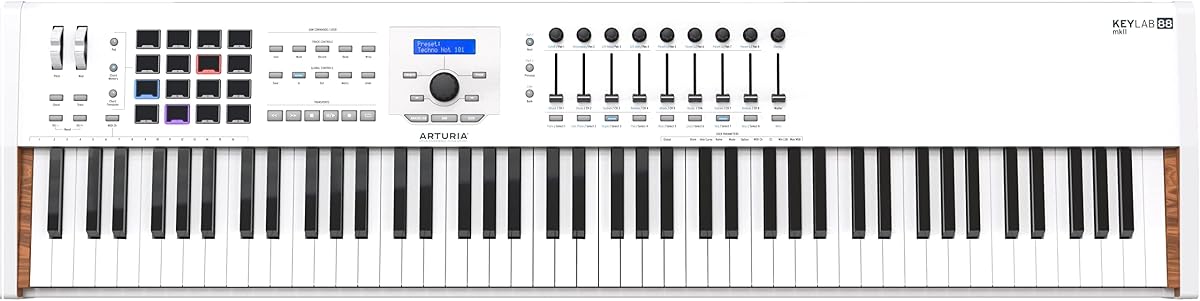
The Arturia KeyLab 88 MkII features a high-quality Fatar TP/100LR keybed that offers a robust piano feel. It is fully equipped with aftertouch and velocity sensitivity for expressive playing and dynamic control.
We may earn a commission when you buy through this link, at no additional cost to you.
Its 16 RGB-backlit performance pads and control bank with 9 faders and 9 rotary knobs provide extensive MIDI control. This layout is excellent for mixing and tweaking multiple parameters across your digital audio workstation.
Included software like Analog Lab V adds significant value by providing access to hundreds of sounds. However you should note that a stand is not included so you will need to purchase one separately if required.
This controller is ideal for producers who need extensive hands-on control over their mixing and sound design. The combination of a quality keybed and comprehensive controls makes it a versatile workhorse for any studio.
The Fatar keybed is renowned for its durability and authentic feel which is essential for serious players.
With nine faders and knobs you have direct access to track volumes and effects without using the mouse.
We may earn a commission when you buy through this link, at no additional cost to you.
The Roland A-88MKII features Roland's own PHA-4 keyboard which provides unmatched playability and responsiveness. It is built to last with wood and premium materials that ensure dependable performance over years of heavy use.
We may earn a commission when you buy through this link, at no additional cost to you.
Its thin design with shallow depth fits today's studio environments without taking up too much desk space. The inclusion of MIDI 2.0 readiness means it is prepared for future advancements in MIDI standards.
Eight RGB-lit assignable knobs and eight RGB-lit pads offer detailed control over sounds and effects. The control application allows for deep customization and instant recall of your specific setup configurations.
This controller is designed for professionals who demand durability and precision in their equipment. The combination of premium materials and advanced features makes it a long-term investment for serious music production.
Built with wood and premium materials it ensures that the controller withstands the demands of professional use.
MIDI 2.0 readiness ensures that you can take advantage of the latest advancements in MIDI connectivity.
We may earn a commission when you buy through this link, at no additional cost to you.
Choosing the right 88 key weighted MIDI controller requires considering several factors that impact your workflow and comfort. This section outlines the most important aspects to evaluate before making your purchase.
Key action is the most critical factor as it determines how your instrument feels under your fingers. Semi-weighted keys are lighter and often preferred for synth work while fully weighted hammer-action keys replicate the feel of an acoustic piano. Choose the action that matches your playing style and the genres you produce most often.
Select a key action that feels comfortable and responsive to your touch for best results.
Deep integration with your Digital Audio Workstation (DAW) can significantly speed up your production workflow. Look for controllers that offer custom scripts or direct mapping for your specific DAW like Ableton Live or Logic Pro. This allows you to control transport, mixing, and plugin parameters directly from the hardware.
Ensure the controller supports your specific DAW for seamless operation.
The build quality affects the durability and longevity of your equipment. Controllers made with wood or premium materials tend to withstand heavy use better than those made primarily of plastic. Consider your environment and how much the controller will be moved around when evaluating build quality.
Prioritize robust materials if you plan to tour or move the controller frequently.
Modern controllers offer various connectivity options such as USB, USB-C, and MIDI 2.0. USB-C is becoming the standard for power and data transfer which simplifies setup and reduces cable clutter. Ensure the controller connects easily to your current computer setup and supports bus power if needed.
Check that the controller supports modern connection standards like USB-C for ease of use.
Many manufacturers include valuable software such as DAW licenses and virtual instruments with their controllers. This bundled software can save you money and give you immediate tools for music production. Review the included software to ensure it offers value for your specific production needs.
Look for useful software bundles that enhance your production workflow immediately.
The layout of knobs, faders, and pads should match how you interact with your music software. Some controllers offer more faders for mixing while others focus on pads for sampling. Evaluate the layout to ensure it provides the controls you need most frequently for your typical projects.
Choose a layout that provides the controls you use most often for efficiency.
If you need to move your studio or perform live the weight and size of the controller matter. 88 key controllers can be heavy so consider if you need a lighter option for travel. Look for features like USB bus power and slimline designs that aid portability.
Select a controller that balances key count with weight if portability is a priority.
Budget ranges vary significantly across the market with options available for every price point. Determine how much you are willing to spend and what features are essential versus nice to have. Remember that investing in a quality controller can improve your workflow and satisfaction in the long run.
Balance your budget with the features you need most to make the best investment.
Start by connecting your controller to your computer using the provided USB cable. Ensure that your DAW is set to recognize the MIDI device which may require selecting it in the preferences menu. Most modern controllers are plug-and-play but installing any dedicated drivers can improve performance.
Keep your controller clean by dusting it regularly with a soft dry cloth. Avoid using harsh chemicals or liquids directly on the keys as this can damage the surface and mechanisms. Storing the controller in a dry environment helps prevent dust buildup and moisture damage.
If you perform live or travel frequently secure your controller in a padded case. This protects the keys and buttons from impacts that could cause misalignment or damage. Regular calibration and checks of your controls ensure that they remain responsive over time.
Semi-weighted keys are lighter and use springs to return to position making them faster for synth playing. Fully weighted keys use hammer mechanisms that mimic the resistance of an acoustic piano for a more natural feel. The choice depends on whether you prioritize speed or authentic piano touch.
Most modern MIDI controllers work plug-and-play without needing drivers on Mac and PC. However installing manufacturer drivers may unlock advanced features or better integration with specific software. Check the product specifications to confirm if drivers are required or optional.
Yes you can use a MIDI controller with iOS devices but you often need an Apple USB Camera Adapter. Ensure your controller supports bus power or you will need an external power source for the adapter. This setup allows you to use your controller with music apps on mobile devices.
NKS integration allows you to browse and control Native Instruments sounds directly from your controller without using the mouse. This streamlines workflow by letting you load presets and adjust parameters quickly during production. It is a valuable feature for producers who rely on Komplete or similar libraries.
Check the product specifications or manufacturer website to see if MIDI 2.0 is listed as a supported feature. MIDI 2.0 offers higher resolution and more data than MIDI 1.0 ensuring future compatibility. Not all controllers support it yet so verify before purchasing if this is a priority.
Use a soft dry cloth to wipe the keys and buttons gently to remove dust and fingerprints. Avoid harsh chemicals or sprays as they can damage the keybed and controls. For deeper cleaning use a small brush to clear dust from between keys without applying liquid.
Choosing the right 88 key weighted MIDI controller is a significant step in setting up a professional music production environment. Whether you value affordability, integration, or premium build quality there is an option on this list that fits your needs.
Prioritize the features that align with your workflow such as key action, connectivity, and software compatibility. Investing in a controller that matches your specific requirements will enhance your creative process and provide years of reliable service.
Always check current availability and specifications before purchasing as product details can change over time. This guide aims to simplify your decision-making process so you can focus on creating music.