
Revopoint MIRACO Plus 3D Scanner
4.5Editor score
Integrated photogrammetric metrology
8-core processor and 32GB RAM
6-inch 2K AMOLED flip screen
Finding the right 3D scanner can transform your creative and professional workflows. Whether you need precise measurements for engineering or vibrant textures for digital art, the market offers diverse options tailored to specific needs.
We evaluated leading models based on accuracy, scanning speed, software capabilities, and real-world performance. Our analysis covers handheld devices, industrial-grade units, and budget-friendly choices to ensure a comprehensive overview.
Each pick highlights unique strengths, ideal use cases, and key trade-offs. Prices and availability may change, so verify details before purchasing. This guide helps you make an informed decision for your next scanning project.
4.5Editor score

5.0Editor score

3.2Editor score
As an Amazon Associate we earn from qualifying purchases.
This side-by-side comparison highlights key specifications and capabilities across the top 10 3D scanners available in November 2026. Use this table to quickly identify which model aligns with your specific requirements and budget.


The Creality Pika Portable is a standout handheld scanner that combines professional-grade precision with unmatched portability. With a perfect 5.0 rating, it excels at capturing intricate details on small parts and collectibles while supporting full-body scans.
We may earn a commission when you buy through this link, at no additional cost to you.
Its dual-mode system allows switching between blue laser for fine details and NIR structured light for large objects. The AI-powered features like body completion and retexturing streamline workflows significantly. Users appreciate the marker-free scanning capability and the ability to export files directly to major CAD software.
While the Pika delivers exceptional accuracy, its cost may be steep for casual users. Additionally, achieving optimal results requires careful calibration. However, these trade-offs are justified for professionals needing reliable, high-fidelity data for reverse engineering or 3D printing.
Buyers seeking a versatile, high-accuracy scanner for both small and large objects should strongly consider the Pika. Its combination of speed, precision, and AI tools makes it a top choice for demanding applications in 2026.
The Pika captures details down to 0.03mm accuracy, making it ideal for miniatures and mechanical components.
Features like automatic hole filling and realistic texture mapping reduce post-processing time significantly.
We may earn a commission when you buy through this link, at no additional cost to you.
The Revopoint POP 4 targets professionals needing industrial accuracy and rapid data capture. Its ability to reproduce fine surface details and complex geometries makes it a robust tool for reverse engineering and precision modeling.
We may earn a commission when you buy through this link, at no additional cost to you.
With a frame rate up to 105 FPS and support for over 5 million points per second, it handles large scenes efficiently. The AI segmentation feature identifies targets in one click, filtering noise automatically. Users value the five distinct scanning modes that cover everything from tiny screws to large machinery.
However, advanced software like Revo Design and Revo Measure are Windows-only and sold separately. Beginners may find the initial calibration and setup challenging. These limitations are minor given the device's capability to perform in harsh outdoor environments up to 100,000 lux.
For engineers and designers working on complex projects, the POP 4 offers an excellent balance of speed and precision. Its versatility across various object types and lighting conditions ensures it remains a top contender this year.
The high frame rate ensures smooth, uninterrupted scanning of large scenes and complex geometries.
Designed to overcome lighting challenges, it provides consistent performance for construction and archaeological work.
We may earn a commission when you buy through this link, at no additional cost to you.
The Revopoint INSPIRE 2 is engineered for portability and reliability in diverse environments. It delivers accurate models suitable for 3D printing and heritage preservation with a lightweight design that fits easily in a backpack.
We may earn a commission when you buy through this link, at no additional cost to you.
Its dual scanning modules allow users to switch between infrared structured light and multi-line laser modes. This flexibility is crucial for capturing dark or reflective surfaces without needing scanning spray. The optical zoom feature helps focus on specific surface details, enhancing versatility.
While it performs well in shaded outdoor conditions, its 20,000 lux limit is lower than premium competitors. Additionally, advanced features require paid software upgrades. Despite this, it remains a top choice for fieldwork requiring lightweight, effective scanning.
Professionals who prioritize mobility and ease of use will find the INSPIRE 2 highly valuable. Its ability to handle challenging surfaces while maintaining high accuracy makes it a practical solution for many industry applications.
Built-in WiFi 6 enables real-time streaming and remote operations for flexible workflows.
The built-in RGB camera captures true-to-life colors, ideal for product design and digital archiving.
We may earn a commission when you buy through this link, at no additional cost to you.
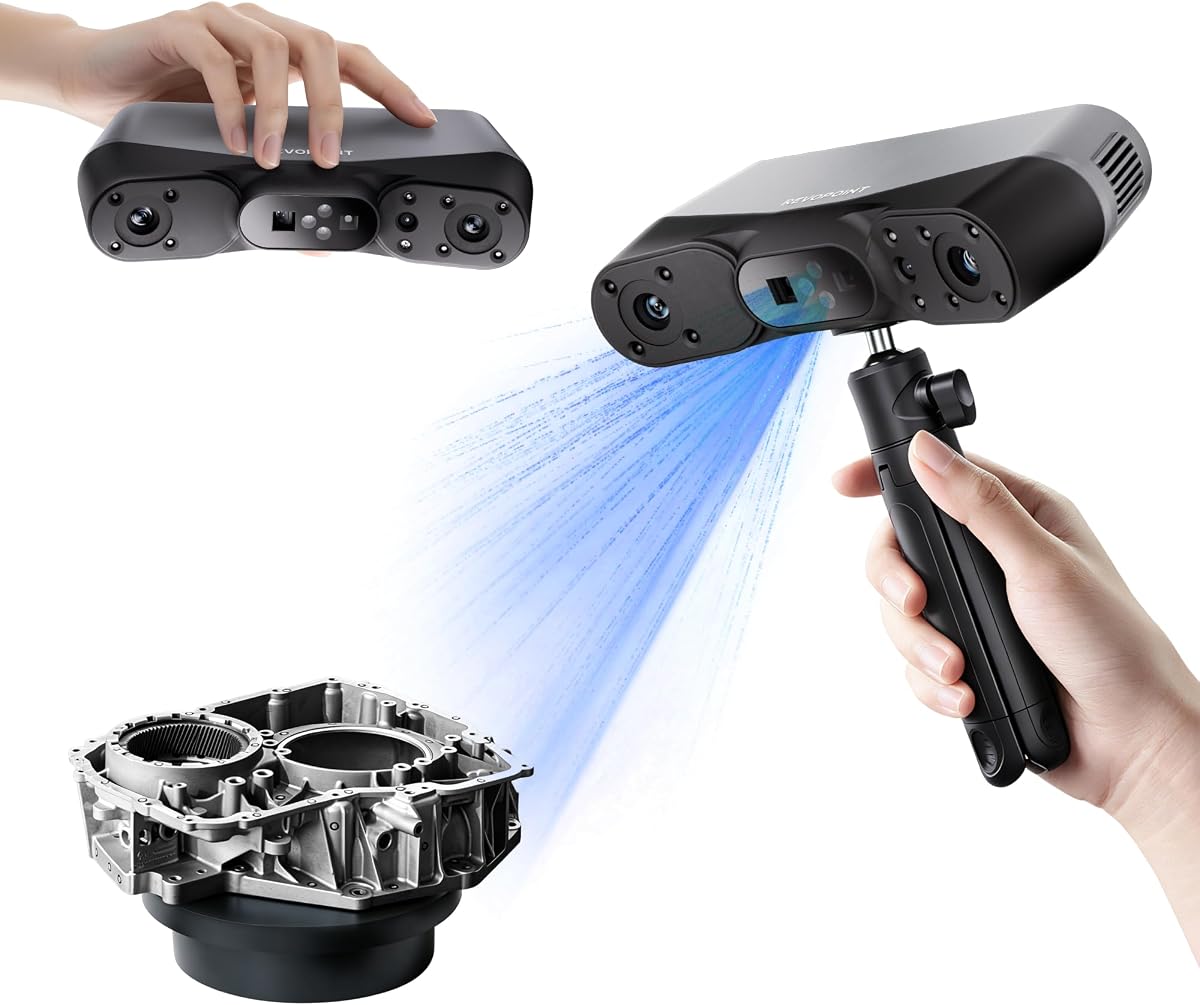
The Revopoint MIRACO Plus represents the pinnacle of standalone handheld scanning technology. It combines high-accuracy scanning with integrated photogrammetric metrology, allowing users to perform precise measurements directly on the device.
We may earn a commission when you buy through this link, at no additional cost to you.
Powered by an 8-core processor and 32GB RAM, it handles complex point clouds without external computers. The 6-inch 2K AMOLED flip screen provides a clear view from any angle. Users appreciate the ability to capture small details on large objects using the included photogrammetric kit.
While the cost is high, the inclusion of advanced hardware and metrology tools offers significant value. The software requires specific architecture, which might limit use on some newer laptops. For professionals needing all-in-one capabilities, the trade-offs are minimal.
For high-end industrial and engineering tasks, the MIRACO Plus delivers unmatched convenience. Its combination of processing power, screen quality, and metrology features sets a new standard for portable scanning in 2026.
The photogrammetric kit enables precise measurements on large objects without external setup.
65W fast charging allows 80% battery in 35 minutes, keeping workflows uninterrupted.
We may earn a commission when you buy through this link, at no additional cost to you.
The Revopoint MetroX Pro is designed for users requiring industrial-grade precision and versatility. Its blue laser technology captures every detail and dimension accurately, meeting needs for precision modeling and industrial measurement.
We may earn a commission when you buy through this link, at no additional cost to you.
Four scanning modes allow handling various scenarios efficiently, from small parts to feature-rich objects. The dual-axis turntable automates complex object scanning with a single click. Users value the real-time streaming capability, which allows mobile monitoring of scan progress.
The device handles shiny or dark surfaces effortlessly, reducing prep time. However, the advanced features come at a higher cost. For those prioritizing accuracy and workflow efficiency, the investment pays off in reliable results.
Engineers and designers dealing with complex industrial parts will find the MetroX Pro highly effective. Its precision and automation features make it a superior choice for professional manufacturing and reverse engineering applications.
One-click automated scans streamline the process of capturing complex objects with high accuracy.
Stream your PC scan to a phone or tablet to detect gaps and move freely during scanning.
We may earn a commission when you buy through this link, at no additional cost to you.
The 3DMakerpro Fox offers an accessible solution for beginners and hobbyists entering the world of 3D scanning. It delivers precision that outperforms typical entry-level scanners, capturing useful details for printing and modeling.
We may earn a commission when you buy through this link, at no additional cost to you.
Markerless AI visual tracking allows the scanner to relock onto objects after moving too fast, reducing frustration during handheld scans. The integrated JMStudio software simplifies the process by combining scanning, editing, and optimizing into one seamless workflow.
While the accuracy is lower than industrial units, it is sufficient for most creative projects. Users may find advanced editing capabilities limited compared to paid software options. However, for entry-level needs, it provides excellent value.
Hobbyists and students seeking an affordable, reliable starter scanner should consider the Fox. Its user-friendly features and reasonable price point make it an ideal choice for learning and personal projects.
Markerless feature recognition relocks onto the object quickly, allowing continuous scanning without markers.
JMStudio handles the hard parts of data processing, letting users focus on capturing the object.
We may earn a commission when you buy through this link, at no additional cost to you.
The Creality Otter Lite Basic stands out with its innovative quad-camera system designed for both fine details and large coverage. It achieves 0.05mm accuracy, making it suitable for precise reverse engineering and prototyping tasks.
We may earn a commission when you buy through this link, at no additional cost to you.
The four-camera setup includes dual long-focal and dual short-focal lenses, covering a wide range of object sizes. True-to-life full color capture ensures realistic models for e-commerce or art. Users appreciate the eye-safe infrared allowing safe face and body scanning.
While the handheld design offers flexibility, stability may require optional bridge handles. Calibration is straightforward but essential for maintaining precision. Despite these minor considerations, the scanner delivers professional-grade performance at a competitive price.
For those needing a versatile handheld solution with strong color capabilities, the Otter Lite is a top contender. Its balance of precision, safety, and usability makes it a reliable choice for varied applications.
Dual focal lenses allow capturing details on small parts and covering large surfaces efficiently.
Infrared technology is Class I laser safe, enabling safe scanning of faces and bodies in about a minute.
We may earn a commission when you buy through this link, at no additional cost to you.
The Creality CR-Ferret SE introduces anti-shake tracking to ensure smooth scanning even with hand movements. This feature significantly increases the success rate, making it ideal for beginners learning handheld scanning techniques.
We may earn a commission when you buy through this link, at no additional cost to you.
With a 2MP camera, it captures vivid colors and intricate details accurately. The flexible range handles medium to large objects efficiently. Users appreciate the optimized capability for scanning black or metal objects without spray, saving prep time.
While the accuracy is lower than industrial units, it remains sufficient for general 3D printing needs. Consistent lighting helps achieve best results. Despite minor limitations, the ease of use and anti-shake tech make it a strong option for entry-level users.
Beginners looking for a forgiving, affordable scanner should consider the Ferret SE. Its focus on stability and ease of use reduces common frustrations associated with handheld scanning.
One-shot 3D imaging enhances tracking efficiency for error-free results even with rapid movements.
Optimized for scanning black or metal objects directly, eliminating the need for powder or spray.
We may earn a commission when you buy through this link, at no additional cost to you.
The Creality CR-Scan Ferret Pro enhances mobility with its wireless capabilities via WiFi6. This allows efficient data transfer and smoother workflows without being tethered to a PC during scanning.
We may earn a commission when you buy through this link, at no additional cost to you.
Features like anti-shake tracking ensure smooth results even with quick movements. It delivers up to 0.1mm accuracy and captures detailed dimensional data. The outdoor performance up to 30,000 lux adds versatility for various environments.
While highly reflective or dark surfaces may pose challenges, general performance is strong. Mobile compatibility is a significant advantage for professionals working on the go. This makes it a versatile tool for mixed workflows.
Users needing wireless freedom and mobile support will find the Ferret Pro beneficial. Its balance of speed, accuracy, and connectivity makes it a practical choice for fieldwork.
WiFi6 offers speeds three times faster than WiFi5 for stable and efficient data transfer.
Powered by upgraded optical technology, it delivers reliable performance in various lighting conditions.
We may earn a commission when you buy through this link, at no additional cost to you.
The Revopoint MetroY Ultra is engineered for flawless capture of intricate geometric details. With precision up to 0.01mm, it is ideal for tight tolerance measurement and industrial inspection tasks requiring extreme accuracy.
We may earn a commission when you buy through this link, at no additional cost to you.
Five versatile scanning modes and ultra-fast 90 FPS speed boost productivity without compromising quality. The no-spray capability for shiny surfaces simplifies preparation. Users appreciate wireless freedom and the long-lasting battery grip for extended field work.
While the cost reflects its industrial capabilities, the efficiency gains justify the investment. The detailed software tools ensure seamless workflow from scanning to final design. This makes it a top tool for demanding professional applications.
Industries requiring high tolerance and speed will benefit significantly from the MetroY Ultra. Its blend of precision, speed, and ease of use positions it as a leading industrial handheld scanner.
Flawlessly capture geometric details with precision suitable for reverse engineering and inspection.
Ultra-fast scanning speed reduces acquisition time and boosts overall productivity.
We may earn a commission when you buy through this link, at no additional cost to you.
Selecting the right 3D scanner requires understanding your specific needs regarding accuracy, object size, and budget. This section breaks down key factors to help you make an informed decision.
Accuracy determines how closely the scanned model matches the real object. For industrial or engineering applications, look for single-frame accuracy of 0.03mm or better. Hobbyists may find 0.1mm acceptable for general printing.
Prioritize devices with high-precision calibration boards to ensure consistent data quality over time.
Faster frame rates allow for smooth, efficient scanning sessions, especially with large objects. Models offering 90 FPS or higher reduce capture time significantly. For small parts, even 30 FPS may suffice.
High-speed scanning minimizes hand shake and ensures detailed data capture in dynamic environments.
If you need to scan outdoors, check the maximum lux tolerance. High-end models can operate up to 100,000 lux. Standard devices might limit you to 20,000 or 30,000 lux.
Ensure the scanner can handle sunlight without losing detail or accuracy during fieldwork.
Quality software is as important as hardware. Look for intuitive interfaces that support post-processing like editing, merging, and exporting. Compatibility with industry-standard CAD tools is crucial for professionals.
Verify if advanced features like AI segmentation are included or require paid upgrades for your operating system.
Wireless options like Wi-Fi 6 offer flexibility during scanning. Ensure the device supports your workflow, whether wired or wireless. Battery life should cover your typical session duration without interruptions.
Long-lasting battery grips are valuable for fieldwork where power outlets are unavailable.
Scanning dark, metallic, or reflective surfaces can be challenging. Some models include advanced laser or structured light modes that eliminate the need for scanning spray.
Check if the scanner handles these difficult materials directly to save prep time and keep surfaces clean.
Weight and form factor matter for handheld devices. Lighter scanners around 200g reduce fatigue. Built-in screens allow for immediate review without external devices.
Ergonomic design ensures comfortable handling during extended sessions, improving scan quality.
Prices range from affordable entry-level options to premium industrial units. Determine your maximum budget and look for the best performance within that range. Consider long-term value, not just upfront cost.
Investing in a slightly higher-end model often pays off in reliability and professional-grade output.
Always calibrate your scanner before starting a new project using the included board. This ensures consistent accuracy and minimizes errors in your final model. Follow the software prompts to complete calibration quickly.
For best results, prepare your object by cleaning dust or fingerprints. Ensure stable lighting conditions unless using a model designed for outdoor or variable light. Keep hands steady or use a tripod for large scans.
Store the scanner in its case to protect lenses and sensors from dust and damage. Keep software updated regularly for new features and bug fixes. Follow manufacturer guidelines for battery maintenance to extend device life.
Most scanners come with dedicated software for scanning and basic editing. For advanced tasks like reverse engineering, you might need paid software. Always check system requirements before purchasing.
Advanced models with laser or structured light can scan shiny or dark surfaces without spray. Transparent objects usually require special sprays or post-processing techniques to capture details effectively.
Accuracy varies by model, ranging from 0.1mm for hobbyists to 0.01mm for industrial units. Check specifications for single-frame accuracy and volumetric accuracy to ensure it meets your needs.
Processing large scans often requires a computer with a good GPU and at least 8GB RAM. Some scanners offer onboard processing, reducing the need for powerful external machines.
Yes, many models support outdoor scanning up to specific lux levels. Check the device's lighting tolerance and consider models with outdoor filters for best performance in sunlight.
Scan time depends on object size and scanner speed. Small objects might take minutes, while large industrial parts could take longer. High-speed models reduce this time significantly.
Whether you need the precision of the Revopoint MetroY Ultra or the affordability of the 3DMakerpro Fox, the right scanner depends on your specific project requirements. Each model offers unique strengths to enhance your workflow.
Prioritize factors like accuracy, software compatibility, and portability when making your decision. Balancing cost with performance will ensure you get the most value for your investment in 3D scanning.
Prices and availability can change, so always verify current details and compatibility before purchasing. Use this guide as a starting point to explore the best options available in November 2026.