
Askar 71F Flat-Field Telescope, 71mm Aperture F6.9 ED Glass Refractor OTA
4.9Editor score
Quadruplet air-spaced APO
Compact 2.5kg weight
360-degree focus rotation
This guide compares the top ten apochromatic refractors for astrophotography and visual astronomy based on optics, build quality, and user feedback.
Apochromatic refractors represent the pinnacle of optical precision for serious astronomers seeking sharp, color-free views. These telescopes use special glass to correct chromatic aberration, delivering crisp images of planets and deep sky objects alike.
We have carefully evaluated ten leading models available today, focusing on optical performance, build quality, and value. Our comparison highlights key features like aperture size, focal ratio, and included accessories to help you choose wisely.
Each selection in this list showcases unique strengths tailored to different observing styles and budgets. Please note that pricing and availability can change frequently, so verify current details before making your final purchase decision online.
4.9Editor score

4.5Editor score

4.2Editor score
The following table provides a side-by-side comparison of all ten selected apochromatic refractors. Review the specifications to understand how each model differs in aperture, focal length, and specialized features for your specific needs.




The SVBONY SV550 AP0 Telescope stands out as a top choice for astrophotographers seeking high contrast without excessive cost. Its rating reflects strong performance in minimizing color fringing during long exposures and visual observation sessions.
We may earn a commission when you buy through this link, at no additional cost to you.
This OTA uses a triplet apochromatic design with one piece of S-FPL51 low-dispersion glass and two correction pieces. This air-spaced triple optical design effectively improves blue-edge chromatic aberration, resulting in bright and high-contrast images for galaxies.
While the optical quality is superb, users must consider the need for a robust mount to handle the weight and length. The magnesium alloy focuser reduces weight significantly but adds complexity to initial setup for beginners.
Ideal for intermediate users upgrading from achromatic refractors, this model offers professional results for deep sky photography. Its extinction measures ensure high quality imagery even under slightly light-polluted conditions.
The triplet structure ensures that stars appear sharp and white across the entire field of view, critical for detailed astrophotography.
Internal light barriers and extinction measures prevent stray light from degrading contrast, allowing faint nebulae to shine through clearly.
We may earn a commission when you buy through this link, at no additional cost to you.
The Askar 71F is a compact powerhouse designed for portability and versatility. With a near-perfect rating, it appeals to travelers and those needing a secondary scope for guiding or wide-field imaging.
We may earn a commission when you buy through this link, at no additional cost to you.
Its quadruplet air-spaced APO design ensures excellent correction of aberrations, making stars look pin-point even at the edges. The built-in flattener simplifies imaging setups by removing the need for additional optics.
The trade-off lies in the smaller 71mm aperture, which gathers less light than larger models. This limits visibility of very faint objects but makes the scope easy to handle on smaller mounts.
Highly recommended for beginners or portable setups, this scope delivers quality optics at a fraction of the cost of premium competitors. Its versatility makes it useful for daytime use as well.
The integrated field flattener saves time and money, making it perfect for quick setup sessions in remote dark sky locations.
Loosening screws allows the focuser to rotate 360 degrees, aiding in precise camera framing without twisting the whole telescope tube.
We may earn a commission when you buy through this link, at no additional cost to you.
Explore Scientific delivers premium optics with the ED80 Essential Series, utilizing genuine FCD1 HOYA extra-low dispersion glass. Its reputation rests on producing views filled with stunning details for both visual and imaging purposes.
We may earn a commission when you buy through this link, at no additional cost to you.
The proprietary enhanced multi-layer coatings on all optical surfaces ensure high contrast and minimal internal reflections. This design makes it suitable for capturing amazing images of nebulae and star clusters with clarity.
A key advantage is the front cell collimation system, which allows for precise adjustments to achieve the tightest stars. This precision engineering supports advanced users who demand optimal alignment for their instruments.
While the investment is significant, the combination of high-quality materials and USA support justifies the cost for serious astronomers. It is an excellent choice for those prioritizing optical excellence over budget constraints.
The FCD1 HOYA glass provides superior correction of color errors, ensuring that the blue edges of stars are free from aberration.
Based in Arkansas, USA, the manufacturer offers excellent customer service, which is crucial when owning high-precision optical instruments.
We may earn a commission when you buy through this link, at no additional cost to you.
This bundle combines the reliable SV550 OTA with the SV209 Field Flattener, offering a complete solution for deep sky astrophotography. The perfect rating suggests users appreciate the seamless integration of these components.
We may earn a commission when you buy through this link, at no additional cost to you.
The flattener corrects field curvature effectively, ensuring stars remain sharp from center to edge. With an M63 extension tube and M48 adapter, the back focal length matches conventional astronomical standards for compatibility.
One downside is the combined weight, which may require a sturdier mount than the standalone unit. However, the inclusion of the flattener simplifies setup and ensures optimal results right out of the box.
Ideal for photographers who want to avoid trial and error with accessory selection, this bundle provides everything needed for high-quality imaging. It is a top choice for dedicated deep sky observers.
The 45mm large target surface of the flattener supports not only half-frame cameras but also full-frame cameras, offering versatility for sensor sizes.
With the M63 extension tube included, users can easily achieve the required 55mm back focal length without hunting for extra parts.
We may earn a commission when you buy through this link, at no additional cost to you.
The SV550 122mm model steps up the aperture game, offering a significant increase in light gathering power. This allows for clearer and detailed images of fainter deep sky objects that smaller scopes might miss.
We may earn a commission when you buy through this link, at no additional cost to you.
Its FPL-51 triplet apochromatic lens structure contains one piece of ED glass, providing better correction of aberration than standard doublets. This enhances the clarity and sharpness of stars and planetary features alike.
While the aperture is a benefit, the weight of 6.44kg requires consideration for travel. The convenient carrying handle helps, but a stable mount is necessary to manage the size effectively.
Best for advanced observers seeking more light without moving to massive instruments, this kit balances performance with manageability. It is a smart upgrade for serious enthusiasts.
The larger 122mm aperture increases the limiting magnitude, allowing users to see fainter deep sky objects with greater detail and brightness.
The 180mm dovetail plate features a hollow design that is easy to set and supports diverse accessories, improving stability on mounts.
We may earn a commission when you buy through this link, at no additional cost to you.
The SV503 offers a solid 102mm aperture with FMC coating to improve light transmission. It is designed for both astrophotography and visual observation, delivering brighter and higher-contrast images.
We may earn a commission when you buy through this link, at no additional cost to you.
The S-FPL51 ED glass minimizes color fringing significantly, ensuring true-to-life color and sharp detail. This makes it perfect for planetary observation and deep-sky astrophotography alike.
One distinct feature is the dual-speed focuser with a 360-degree field rotator, allowing for easy camera alignment without tube rotation. This facilitates precise framing during imaging sessions.
Ideal for users who want a versatile scope for multiple uses, this model balances optical performance with practical features. Its retractable hood adds protection against dew and stray light.
With 90mm of focus travel, users have ample room to accommodate various accessories like filter wheels and field flatteners without issues.
The built-in field rotator ensures perfect camera alignment, reducing the need to physically rotate the telescope tube for framing.
We may earn a commission when you buy through this link, at no additional cost to you.
This bundle adds the SV209 focal reducer to the 122mm OTA, creating a versatile wide-field imaging system. The perfect rating reflects its success in addressing field curvature and edge defects.
We may earn a commission when you buy through this link, at no additional cost to you.
The SV209 field flattener improves the quality and shooting efficiency of the edge of the field of view. This is crucial for astrophotographers who demand sharp stars across the entire sensor.
While the aperture is large, the inclusion of the reducer makes it more manageable for wider targets. However, the weight remains a consideration for portable setups compared to smaller scopes.
Ideal for advanced photographers seeking large field-of-view coverage without sacrificing detail, this kit offers comprehensive optical correction. It is a top choice for nebulae and large galaxies.
The 0.8X focal reducer shortens the effective focal length, allowing for shorter exposure times and wider framing of large deep sky objects.
Correcting field curvature ensures that stars at the corners of the frame remain round and sharp, essential for professional-looking images.
We may earn a commission when you buy through this link, at no additional cost to you.
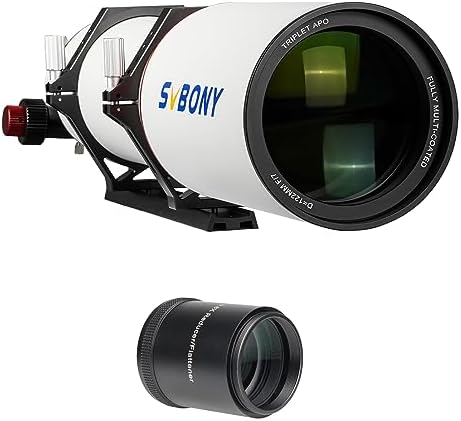
This kit provides a complete solution for 122mm astrophotography by including necessary accessories like the reducer and flattener. It offers clear and detailed images suitable for deep sky photography.
We may earn a commission when you buy through this link, at no additional cost to you.
The 122mm aperture gathers more light than smaller scopes, offering better visibility of faint deep sky objects. The FPL-51 triplet lens ensures high contrast and minimal chromatic aberration throughout the image.
While the accessories add value, the setup requires experience to align correctly. The portable handle helps with transport, but the total weight still requires sturdy support equipment for stability.
Recommended for those ready to invest in a comprehensive imaging system, this kit delivers high-quality optics and hardware. It balances light power with optical correction effectively.
By including the field flattener and focal reducer, this kit removes the guesswork of selecting compatible accessories, ensuring optimal performance out of the box.
The 122mm aperture ensures that faint deep sky objects are visible with clarity, surpassing the capabilities of 80mm alternatives significantly.
We may earn a commission when you buy through this link, at no additional cost to you.
This kit is designed to be simple for users observing Messier catalog targets and common shooting targets. The difficulty factor is kept low to help beginners succeed quickly in astrophotography.
We may earn a commission when you buy through this link, at no additional cost to you.
The ultra wide band fully multilayer coated lens reduces irritation from reflections. Additionally, the image is inverted when used with an eyepiece which is normal for this optical configuration.
One consideration is the weight of the scope combined with accessories, which may require a sturdy tripod. However, the comfortable carrying handle makes it easy to move for sessions.
Perfect for new astrophotographers, this kit offers high-quality optics without the complexity of custom setups. The included flattener ensures sharp stars across the frame.
The design focuses on simplicity, allowing beginners to set up and shoot quickly without extensive technical knowledge or custom modifications.
The wide band coating ensures bright and clear images, enhancing visibility of subtle details in nebulae and star clusters.
We may earn a commission when you buy through this link, at no additional cost to you.
This bundle is designed for those needing a complete guiding and imaging system. The included 1.23-megapixel color camera offers high peak QE for tight tracking of faint guide stars.
We may earn a commission when you buy through this link, at no additional cost to you.
The telescope camera features small pixels and low read noise, making it perfect for autoguiding or planetary imaging. It is compatible with mainstream auto guiding cameras for maximum versatility.
However, the system weight with camera and guide scope requires a very stable mount. The cost is high, but it provides an all-in-one solution for tracking precision.
Ideal for users wanting to avoid buying separate guide equipment, this kit ensures compatibility and performance. It represents a comprehensive approach to astrophotography.
The dedicated guide camera allows for precise tracking of faint stars, which is critical for capturing clear images during long exposures.
The camera interfaces with standard mounts, ensuring that users can upgrade or adjust their setup without losing compatibility with existing equipment.
We may earn a commission when you buy through this link, at no additional cost to you.
Selecting the right apochromatic refractor requires balancing aperture, focal ratio, and intended use. Consider these factors to find the model that fits your specific needs.
Aperture determines light gathering power and resolution. Larger apertures like 122mm reveal fainter deep sky objects better than smaller 80mm or 71mm models.
Choose a size that matches your mount capacity and portability needs for regular stargazing sessions.
Focal ratios like F6 or F7 affect image scale and exposure times. Shorter ratios allow for wider fields and shorter exposures, while longer ones offer more detail.
Match the ratio to your imaging goals, balancing speed with desired detail levels in your photos.
APO refractors use ED glass like FPL-51 to minimize color fringing. Higher quality glass ensures sharper stars and better color fidelity.
Look for triploid designs with low-dispersion glass for the best correction.
A dual-speed focuser with high precision is vital for critical focus. Magnesium alloys reduce weight while maintaining rigidity.
Ensure the focuser can handle your camera and accessories without flexing.
Bundles with field flatteners or reducers add significant value. Check if these are included or must be purchased separately.
A complete package saves money and simplifies setup for new users.
Ensure the dovetail plate size matches your mount. Standard Vixen or Losmandy styles are common for easier integration.
Check weight limits to ensure stable tracking during long exposures.
High-quality internal baffles and light barriers improve contrast. Aluminum or magnesium bodies offer durability and thermal stability.
Invest in robust construction to protect your optical investment.
Compare prices against included features. A bundle with a guide scope may be more valuable than a standalone OTA.
Prioritize features that enhance your specific workflow over unnecessary extras.
Allow your telescope to acclimate to outside temperatures before observing to prevent dew and internal currents. This stabilizes the optics for sharper images.
Use the focuser slowly and precisely to achieve critical focus. Avoid touching the optical surfaces during setup or maintenance to prevent scratches.
Store your scope in a dry environment and use a dew shield when observing. Regularly check the collimation to ensure the best possible star images.
An apochromatic refractor is a telescope that uses special glass to correct chromatic aberration. Unlike standard refractors, APOs ensure all colors focus at the same point for sharper stars.
Yes, they provide high contrast and minimal color fringing essential for long exposures. This makes them the preferred choice for imaging deep sky objects and planets.
Many APOs require a flattener to correct field curvature for flat sensors. Check your specific model to see if one is included or recommended for your setup.
An 80mm aperture is ideal for beginners as it balances light gathering with portability. It offers sufficient power to see deep sky objects without being too heavy.
Yes, they provide excellent views of terrestrial objects due to their sharp optics. Just ensure you use appropriate filters to protect your eyes from direct sun.
APOs rarely need collimation, but you may need it after shipping or impact. Check star images periodically to ensure optical alignment remains optimal for clear views.
Most APOs fit standard equatorial mounts with Vixen or Losmandy dovetails. Ensure your mount can support the total weight including accessories and cameras.
We have reviewed ten outstanding apochromatic refractors ranging from portable 71mm options to powerful 122mm bundles. The SVBONY and Askar models offer excellent performance across various budgets and skill levels.
Prioritize your primary use case, whether it is visual observation or deep sky imaging. Ensure the chosen model has the right optics and accessories for your specific goals.
Please verify current prices and availability before purchasing as these can fluctuate. The right APO will provide years of clear views of the universe.