
Revopoint INSPIRE 2
4.6Editor score
0.05mm accuracy
Lightweight 190g design
Wireless WiFi 6 streaming
This guide compares the top 3D scanners for reverse engineering, highlighting precision, speed, and features for industrial and design workflows.
Reverse engineering demands precise digital capture of physical objects to recreate designs or analyze parts. A high-quality 3D scanner for reverse engineering ensures accurate geometry, fast scanning, and compatibility with CAD software for seamless workflows.
We evaluated leading models based on accuracy, scanning speed, surface handling, and software integration. Our list includes handheld, portable, and industrial-grade options suitable for various applications from automotive to product design.
Each pick highlights key strengths, pros, cons, and ideal use cases to help you choose confidently. Note that prices and availability may change, so verify current details before purchasing your next scanner.
4.6Editor score

4.8Editor score

4.9Editor score
The following table compares all ten models across key specifications to help you quickly identify the best fit for your reverse engineering needs.



The Revopoint MetroX Pro stands out as the top choice for reverse engineering due to its industrial-grade blue laser technology and exceptional accuracy. With single-frame precision of up to 0.01 mm and volumetric accuracy of 0.02 mm + 0.04 mm × L (m), it captures intricate details flawlessly. This makes it ideal for tight tolerance measurement and creating precise digital twins of physical parts.
We may earn a commission when you buy through this link, at no additional cost to you.
Its four scanning modes offer unmatched versatility. The 30 cross-line lasers efficiently capture flat, shiny, or dark surfaces without spray, while 15 parallel lines focus on fine features and edges. The full-field blue structured light allows marker-free scans of feature-rich objects at up to 7 million points per second. Additionally, the PC-to-mobile real-time streaming via Revo Mirror lets you view scans on a tablet or phone, freeing you to move around the workspace.
Trade-offs include the premium price and reliance on optional software like Revo Design for full CAD workflows. However, the accuracy and speed justify the investment for professionals. The one-click automatic turntable scanning simplifies capturing complex objects, though it requires the dual-axis turntable. Despite these minor limitations, its performance in industrial inspection and design workflows is unmatched in its class.
Buy the MetroX Pro if you need reliable, high-precision scans for reverse engineering, quality inspection, or prototyping. Its ability to handle challenging surfaces and fast data acquisition makes it perfect for engineers and designers who demand accuracy. It bridges the gap between industrial measurement and creative design effectively.
The blue laser avoids noise on reflective surfaces, ensuring clean scans without spray. This saves prep time and protects delicate parts during inspection.
Revo Metro supports seamless export to Revo Measure or Design, enabling smooth transitions from scan to CAD. This streamlines reverse engineering tasks significantly.
We may earn a commission when you buy through this link, at no additional cost to you.
The Revopoint MetroY Ultra is a premium powerhouse delivering up to 90 FPS scanning speed, making it the fastest option for reverse engineering workflows. With 0.01 mm single-frame precision and volumetric accuracy of 0.015 + 0.04 mm x L (m), it captures intricate geometric details flawlessly. Its blue laser technology ensures reliable scans of black, high-gloss, and metallic components without spray, preserving delicate parts.
We may earn a commission when you buy through this link, at no additional cost to you.
This model excels in flexibility and mobility. The included 5500 mAh battery grip provides 2.5 hours of stable power for field work, while Wi-Fi 6 allows cable-free control via Revo Mirror on tablets or phones. It handles outdoor environments up to 100,000 lux, enabling inspections on-site without lab constraints. Five scanning modes adapt to everything from small parts to medium objects.
While its speed and battery life are impressive, it requires an NVIDIA GPU for peak 90fps performance, which may limit some users. The price reflects its advanced features but may be steep for casual hobbyists. However, for professionals needing rapid, high-fidelity data acquisition in diverse settings, it offers unmatched productivity and reliability.
Choose the MetroY Ultra if you prioritize speed, wireless mobility, and outdoor capabilities for reverse engineering. Its combination of accuracy, battery life, and robust software exports makes it ideal for industrial teams, automotive professionals, and designers working in varied environments.
Wi-Fi 6 and battery grip enable untethered scanning anywhere. This enhances efficiency on construction sites or large factory floors.
Despite 90fps speeds, accuracy remains at 0.01mm. This balance allows quick large-area scans without compromising detail quality.
We may earn a commission when you buy through this link, at no additional cost to you.
The EinScan Rigil redefines portability with true wireless standalone operation, eliminating cables for seamless reverse engineering. Its hybrid Blue Laser + IR VCSEL technology delivers ultra-precise 0.04mm accuracy, capturing vibrant textures via a 5MP camera. With onboard computing (2.4GHz CPU, 32GB RAM, 1TB SSD), it processes scans instantly without a PC connection, ideal for field teams.
We may earn a commission when you buy through this link, at no additional cost to you.
Five laser lines (25+25 crossed, 7 parallel) enable precise scanning of dark or shiny metal surfaces without spray. The 6.4-inch 2K AMOLED touchscreen enhances usability, and replaceable batteries allow extended on-the-go sessions. It includes personal online training, ensuring quick mastery of its features. This all-in-one solution is perfect for automotive, design, and engineering applications needing mobility and speed.
Its weight and price position it as a premium investment, but the freedom of wireless scanning justifies it for many professionals. The onboard storage and processing mean no data transfer delays. While it may be overkill for simple tasks, its capabilities in challenging lighting conditions and complex geometries make it a top-tier choice for high-end reverse engineering.
Invest in the Rigil if you need a self-contained, wireless scanner with high accuracy and processing power. Its hybrid technology and touchscreen workflow are unmatched for teams that move between locations and require immediate access to high-quality digital data.
Wi-Fi 6 and onboard computing let you scan anywhere without a laptop. This enhances efficiency on large or remote jobs.
Combining laser and VCSEL ensures 0.04mm accuracy on varied materials. This handles reflective surfaces better than single-source scanners.
We may earn a commission when you buy through this link, at no additional cost to you.
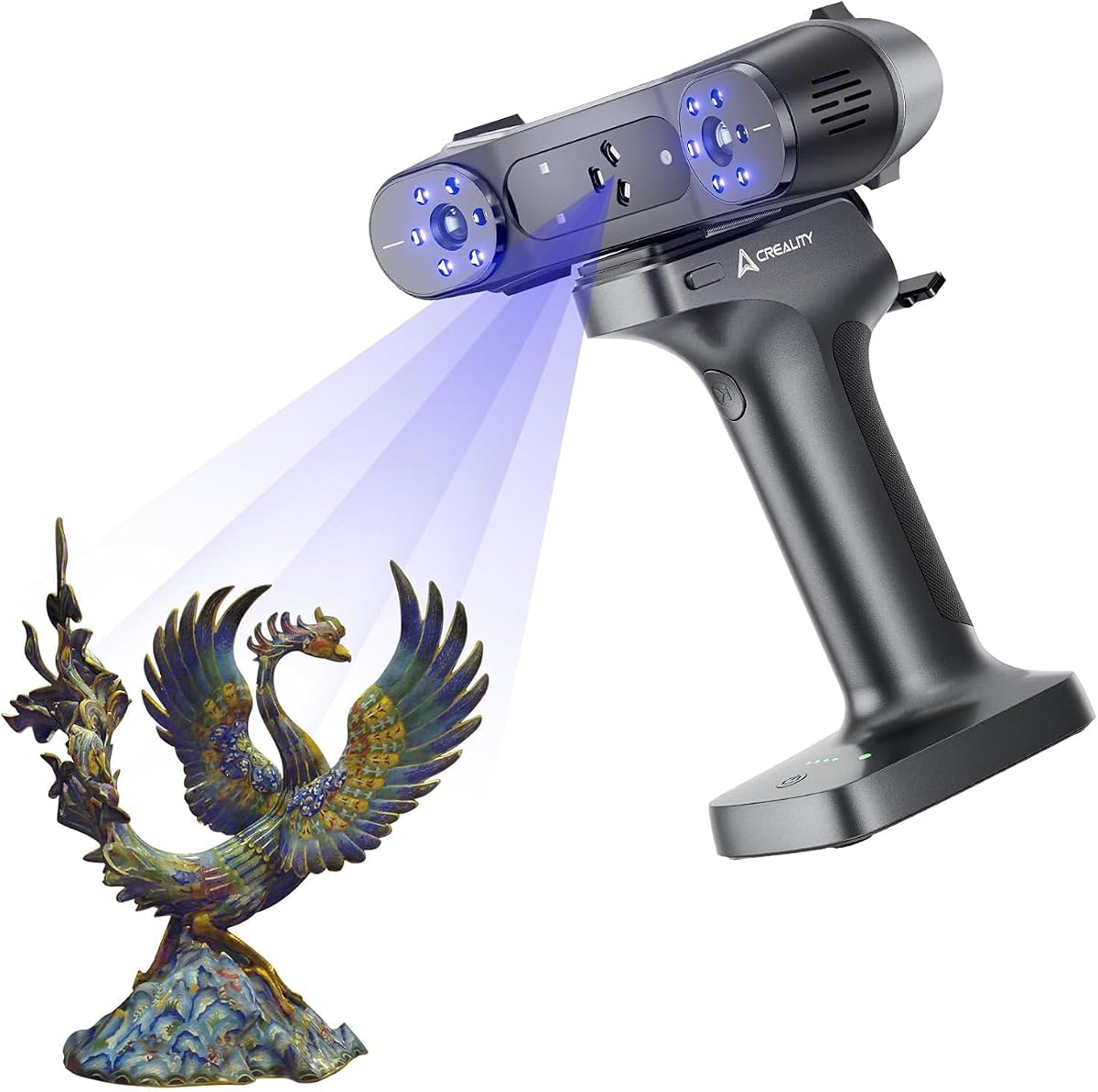
The Creality CR-Scan Raptor Pro excels in scanning large objects, with a range from 5mm to 4000mm. Equipped with 22 crossed blue lasers and 7 parallel blue lasers plus NIR infrared structured light, it captures details at up to 660,000 dots per second. Its temperature compensation ensures stability in extreme environments, while no-spray technology handles black and metallic objects directly.
We may earn a commission when you buy through this link, at no additional cost to you.
It supports face and body scanning modes, capturing full human bodies in just two minutes. True-color rendering via RGB camera restores vibrant textures for realistic digital twins. Compatible with Geomagic, Rhino, and SolidWorks, it integrates smoothly into professional workflows. Anti-shock algorithms reduce interruptions for smoother handheld experience.
Its hardware requirements may be a barrier for users with older PCs. However, its versatility for automotive modification, industrial design, and reverse engineering makes it worthwhile. The ability to scan large parts without multiple passes saves significant time. It balances performance and usability well for mixed-size projects.
Choose the Raptor Pro for diverse projects ranging from small engineering parts to large vehicles. Its color accuracy and broad size range make it ideal for automotive, medical, and prototyping applications requiring detailed and fast data capture.
The wide scanning range reduces need for multiple setups. This is crucial for reverse engineering of car parts or industrial equipment.
24-bit color mapping enhances model realism. This aids visualization in design reviews and heritage preservation projects.
We may earn a commission when you buy through this link, at no additional cost to you.
The Revopoint INSPIRE 2 is an affordable option delivering up to 0.05mm accuracy and 0.03mm precision. At just 190g, it is one of the lightest scanners available, making it perfect for extended use. Its infrared structured light and multi-line laser modes handle reflective or dark surfaces without spray, ensuring reliable data for reverse engineering tasks.
We may earn a commission when you buy through this link, at no additional cost to you.
Dual scanning modules boost efficiency for varying materials and environments. The optical zoom (1.5x, 2x) captures fine details on mixed surfaces. Outdoor performance up to 20,000 lux allows flexible use. Revo Metro software supports import to Revo Design for CAD workflows, simplifying the process from scan to model.
While slower than high-end models and dependent on PC connectivity, its value proposition is strong for small businesses or hobbyists. It covers essential needs without high costs. The included accessories and portable design make it ready out-of-the-box for immediate reverse engineering projects.
Buy the INSPIRE 2 if you need precision scanning on a budget without compromising too much on features. It is ideal for small teams, students, and hobbyists working on product design, 3D printing, and basic reverse engineering projects.
Lightweight design reduces fatigue during long sessions. This helps with field scanning or multiple project runs in a day.
0.05mm accuracy is sufficient for many engineering tasks. This balance of cost and performance appeals to startups.
We may earn a commission when you buy through this link, at no additional cost to you.
The Creality Otter Lite Basic offers professional-grade 0.05mm resolution with dual-mode scanning for close and long-range needs. Its 235g lightweight design makes it highly portable for quick scans. RGB and infrared cameras capture true-to-life colors at 30fps, exporting to OBJ, STL, or PLY formats for various uses. LED indicators guide optimal distance for easier user experience.
We may earn a commission when you buy through this link, at no additional cost to you.
It supports Windows and macOS via Creality Scan software, with QR access to tutorials for quick onboarding. The kit includes turntable, markers, calibration board, and carrying case, providing everything needed to start immediately. This makes it ideal for DIY enthusiasts and small workshops focused on reverse engineering simple parts.
While best for small to medium objects, its limitations in large-scale scanning are acceptable for its price. The auto-scanning feature reduces manual effort significantly. Its user-friendly nature lowers the learning curve, making it accessible for those new to 3D scanning technology.
Choose the Otter Lite Basic for easy, cost-effective reverse engineering of small parts or prototypes. Its complete package and intuitive interface make it perfect for home makers, educators, and small businesses needing reliable scanning without complexity.
LED indicators and plug-and-play design simplify operations. This reduces setup time and helps beginners start faster.
Included accessories mean no additional purchases needed. This is great for new users wanting a ready-to-go solution.
We may earn a commission when you buy through this link, at no additional cost to you.
The Revopoint MetroX Pro Standard delivers industrial-grade blue laser scanning with single-frame precision up to 0.01 mm and accuracy up to 0.02 mm. Its four scanning modes, including 30 cross-line lasers, efficiently capture flat, shiny, or dark surfaces at 7 million points per second. The auto turntable simplifies complex object scans, while Revo Mirror app enables real-time streaming.
We may earn a commission when you buy through this link, at no additional cost to you.
It offers three tracking modes: feature, marker, and global marker, adaptable to various object types. Revo Metro software facilitates editing and merging, exporting to Revo Measure or Design for CAD workflows. Its versatility for precision modeling, industrial measurement, and prototyping makes it a robust choice for professionals seeking accuracy.
Paid software options and PC requirements add to total cost but remain reasonable for the precision offered. The dual-axis turntable automation enhances efficiency for repetitive tasks. This model stands out for its balance of speed, accuracy, and usability in professional settings.
Opt for the MetroX Pro Standard if you need reliable high-precision scanning without the ultra-fast speeds of premium models. It is ideal for quality inspection, reverse engineering, and prototyping in manufacturing and design environments where accuracy is critical.
Multiple tracking modes adapt to surface types. This ensures accurate results on complex or feature-poor objects.
One-click turntable scans save manual effort. This is valuable for batch scanning identical parts efficiently.
We may earn a commission when you buy through this link, at no additional cost to you.
The Creality Raptor Pro is built for metrology-grade accuracy up to 0.02mm, capturing up to 660,000 points per second. Its blue and NIR infrared lasers scan medium to large objects flawlessly, ideal for automotive components. Works outdoors up to 100,000 lux, ensuring high-precision scanning anywhere. CrealityScan software provides step-by-step tutorials and advanced editing tools for seamless workflows.
We may earn a commission when you buy through this link, at no additional cost to you.
It supports face and body scanning, capturing human forms in two minutes. The no-spray technology handles high-gloss and metallic parts, protecting them during inspection. With global marker scanning and anti-shock algorithms, it ensures smooth handheld operation. Its versatile size range from 5mm to 4000mm suits diverse projects.
Hardware requirements may be demanding for some users, but performance justifies it for professional teams. The outdoor readiness makes it ideal for on-site automotive reverse engineering. Its combination of speed, accuracy, and software tools supports industrial design and medical applications effectively.
Pick the Raptor Pro for automotive, industrial, or large-scale reverse engineering where speed and outdoor durability matter. Its robust features make it a strong choice for teams needing metrology-grade data in challenging environments.
Withstands harsh sunlight for field work. This is crucial for scanning vehicles or equipment outside the lab.
CrealityScan app simplifies post-processing. This reduces time from scan to actionable CAD model significantly.
We may earn a commission when you buy through this link, at no additional cost to you.
The Creality Raptor X features 34 cross blue laser lines for 0.02mm accuracy, scanning medium to large objects efficiently. Its wireless handle supports WiFi 6 transmission with low latency, allowing quick data transfer to PCs. The 35400mWh battery charges to 80% in 1.5 hours, making outdoor scanning convenient. Anti-shake technology and markerless scanning streamline handheld use.
We may earn a commission when you buy through this link, at no additional cost to you.
It scans objects from 5mm to 4000mm, covering engineering parts to automobiles. The face and body mode maps details quickly in 2 minutes. With strong material adaptability, no powder spraying is required for metal parts. This model redefines portability and speed for professional reverse engineering teams.
Its battery life and wireless features are standout advantages for field work, though price is higher. It handles large surfaces with single-pass efficiency, saving time. The detailed capture ensures reliable data for complex geometries and design reviews.
Choose the Raptor X for large-scale reverse engineering needing wireless mobility and fast charging. It suits automotive, engineering, and architectural teams requiring detailed scans of big objects with minimal setup.
Large capacity ensures long sessions without outlet. This enables continuous field work without interruptions.
WiFi 6 transmission reduces cabling needs. This enhances mobility and setup speed in varied locations.
We may earn a commission when you buy through this link, at no additional cost to you.
The Creality Raptor Pro delivers 0.02mm metrology-grade accuracy with 660,000 points per second speed. Its upgraded dual blue laser mode (22+7) covers medium to large objects efficiently. NIR structured light enables markerless scanning of feature-rich workpieces. Compatible with Windows/macOS, its software offers multi-project stitching and adjustable resolution.
We may earn a commission when you buy through this link, at no additional cost to you.
It handles objects between 5mm to 4000mm, perfect for engineering parts, molds, and human bodies. The unique face mapping algorithm captures details like hair quickly in 2 minutes. No powder spraying is required for black or metal objects. This versatility supports industrial inspection and detailed 3D modeling.
While setup may require attention to hardware specs, its performance makes it a top contender for reverse engineering. Its broad size range and color capture enhance workflows. It balances speed, accuracy, and usability well for diverse applications.
Select the Raptor Pro for versatile reverse engineering tasks across automotive, artifact, and body scanning. Its metrology-grade precision and adaptable scanning modes make it ideal for professionals needing reliable results across varied project types.
Crossed and parallel lines handle varied geometries. This ensures consistent quality on complex or flat surfaces.
Windows and macOS compatibility fits diverse labs. This allows teams to choose preferred operating systems easily.
We may earn a commission when you buy through this link, at no additional cost to you.
Selecting the right 3D scanner for reverse engineering requires evaluating several critical factors to ensure compatibility with your workflow and projects.
Accuracy determines how closely the digital model matches the physical object. For reverse engineering, look for scanners with 0.05mm or better accuracy to ensure parts fit and function as designed. Precision refers to repeatability, critical for quality control.
Prioritize models with industrial-grade accuracy if your work involves tight tolerances or certification requirements.
Fast scanning speeds increase productivity, especially for large objects. Models offering 60 FPS or higher reduce time spent capturing data. Speed also impacts how easily you can capture moving parts or work in dynamic environments.
Balance speed with accuracy; faster scanners may trade detail for throughput depending on use case.
Reverse engineering often involves shiny, dark, or reflective surfaces. Scanners with blue laser or infrared structured light can scan these without spray. This saves time and avoids contaminating delicate parts during inspection.
Verify the scanner handles your typical materials; spray-free scanning is highly recommended for industrial workflows.
Wireless WiFi 6 and battery-powered scanners offer freedom for field work. Wired models may be more stable but limit movement. Consider whether your projects are lab-bound or require mobility.
For outdoor or on-site reverse engineering, choose models with strong wireless capabilities and long battery life.
Software bridges scanning to CAD modeling. Ensure compatibility with tools like SolidWorks or Rhino. Look for features like mesh editing, alignment, and export formats such as STL or PLY.
Check if additional software is included or sold separately, as this affects total cost and workflow efficiency.
Determine the typical object size you scan. Some models excel at small parts (5mm to 100mm), others at large objects (up to 4000mm). Multi-mode scanners offer flexibility for varied sizes.
Select a scanner covering your full range to avoid needing multiple devices for different project types.
Full-color texture capture is vital for visual fidelity and heritage preservation. RGB cameras embedded in scanners map colors onto 3D geometry, enhancing realism for design reviews.
If color detail matters for your applications, choose models with 24-bit full-color scanning capabilities.
Reverse engineering software often demands powerful GPUs and CPUs. Verify your computer meets minimum specs to run scanning software smoothly. Higher end models need i7 processors and dedicated graphics cards.
Budget for necessary hardware upgrades to ensure the scanner performs at its best.
Begin by calibrating your scanner using the provided board and software. Follow manufacturer steps to ensure accuracy. Clean lenses and sensors before each use to avoid artifacts in scans. Proper calibration reduces errors and saves time during processing.
Prepare objects by cleaning surfaces; some scanners require markers for alignment. Use markers only when necessary to avoid affecting surface properties. For shiny parts, consider matte sprays if your scanner cannot handle them without. Maintain stable lighting to ensure consistent data capture.
After scanning, use software tools to merge point clouds and repair mesh holes. Export to CAD in formats compatible with your design software. Store models securely and back up data. Clean the scanner regularly and store it in a dry case to prolong its life and accuracy.
For professional reverse engineering, accuracy of 0.05mm or better is ideal to ensure parts meet exact dimensions. Higher-end models offer 0.01mm to 0.02mm for critical tolerances. Always match scanner accuracy with the required tolerance of your projects for best results.
Yes, many modern scanners using blue laser or infrared technology can scan shiny surfaces without spray. Models like the Revopoint MetroX Pro or EinScan Rigil handle reflective materials directly. This prevents contamination and reduces prep time significantly.
Most professional models require a PC with an i7 CPU and dedicated NVIDIA GPU to handle data processing smoothly. Minimum configurations vary but often include at least 16GB RAM. Check system specs before buying to avoid performance bottlenecks during scanning.
Yes, models like the Creality CR-Scan Raptor Pro can scan objects up to 4000mm including car parts or entire vehicles. Look for scanners with wide scanning ranges and fast speeds to cover large areas efficiently without repeated setup.
Some scanners are built for outdoor use with sunlight resistance up to 100,000 lux. Models with blue laser and NIR structured light perform better outdoors. Ensure your chosen device has outdoor ratings for field reverse engineering projects.
Common export formats include STL, PLY, OBJ, and 3MF which are compatible with most CAD and 3D printing software. Always verify that your scanner exports to formats required by your design workflow for seamless integration.
Calibration involves placing the provided board in front of the scanner and following software prompts to adjust settings. Perform calibration regularly, especially after moving the device or changing environments. Proper calibration maintains accuracy and reduces scanning errors over time.
The best 3D scanners for reverse engineering combine high accuracy, speed, and flexibility to meet diverse industrial needs. Top picks like the Revopoint MetroX Pro and EinScan Rigil lead with precision and wireless capabilities for professional workflows.
Prioritize accuracy and surface handling when selecting a scanner to ensure reliable data for your designs. Consider software compatibility and connectivity options to streamline your reverse engineering process from start to finish.
Always verify current prices and availability before purchasing as they fluctuate frequently. Choose the model that best aligns with your specific reverse engineering requirements to maximize productivity and output quality.