
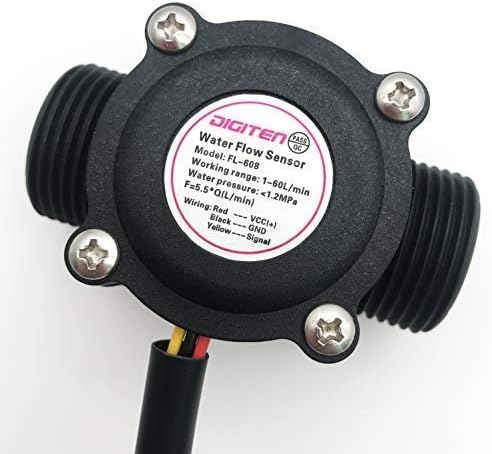
DIGITEN G3/8" Water Flow Sensor
4.5Editor score
Low 0.3 to 10 L/min range
Compact waterproof design
Compatible with Arduino and Pi
Arduino flow meters are essential for monitoring water usage in smart home and industrial automation projects. These sensors provide precise data for irrigation, drinking systems, and leak detection. Choosing the right one ensures accurate measurements and long-term reliability.
We compared ten top-rated models based on flow range, build quality, and compatibility with Arduino boards. Each product was evaluated for ease of installation, signal output, and suitability for potable water. Our analysis highlights the best options for different project needs.
Each pick shows key specs like thread size, voltage, and flow limits to help you decide. These sensors vary from compact household units to robust industrial meters. Prices change frequently, so check current listings before purchasing your next flow sensor.
4.5Editor score

5.0Editor score

4.9Editor score
As an Amazon Associate we earn from qualifying purchases.
Here is a side-by-side comparison of all ten flow meters. We highlight their key specs to help you find the perfect fit for your Arduino project.


This 1/2 inch flow hall sensor offers a reliable way to measure water flow in Arduino projects. With a rating of 4.7 stars, it is highly regarded for its lightweight build and easy installation. The NPT thread ensures a secure fit in most piping setups.
We may earn a commission when you buy through this link, at no additional cost to you.
The integrated magnetic hall effect sensor outputs an electrical pulse with every revolution, allowing precise flow counting. It is sealed from the water pipe to keep the electronics safe and dry. This makes it perfect for continuous monitoring without risking water damage.
While it is lightweight and nimble, you must ensure correct flow direction during installation to get a signal. Also, if your pipes are not NPT, you may need adapter fittings. These minor trade-offs are acceptable given the sensor's durability and accuracy.
This sensor is best for home automation, coffee machines, or small water purifiers. It delivers consistent performance for flows between 1 and 30 liters per minute. We recommend this as a solid choice for most general Arduino flow meter applications.
The hall effect sensor is sealed away from water to prevent corrosion and electrical shorts.
Every rotation generates a clean pulse for accurate flow rate calculation via Arduino.
We may earn a commission when you buy through this link, at no additional cost to you.
The DEVMO 1/2 inch water flow hall sensor stands out for its high amplitude signal output. With a near perfect rating of 4.9 stars, it is trusted for precise fluid measurement in demanding environments. It excels where signal clarity and electrical strength are paramount.
We may earn a commission when you buy through this link, at no additional cost to you.
Its high amplitude ensures the signal is robust enough for reliable detection by microcontrollers. The electric strength rating of 1250V per minute provides excellent insulation. This makes it ideal for industrial or heavy use cases like water testing and cooling systems.
The main trade-off is that it tops out at 30 liters per minute, limiting very high flow use. However, for most standard applications, this range is ample. The signal quality justifies the cost over standard sensors.
Choose this sensor if you need top notch signal integrity and electrical safety. It works great with Arduino for credit card machines or vending systems. We rank it as the best premium option for high quality monitoring.
Withstand high voltage stress with a strong electric strength rating for safety.
High amplitude ensures your Arduino reads flow data without signal noise.
We may earn a commission when you buy through this link, at no additional cost to you.
This DIGITEN G1.5 inch water flow sensor has a perfect 5.0 rating, indicating unmatched quality and performance. It handles a massive flow range from 5 to 150 liters per minute, suitable for industrial or high volume domestic systems. The build uses potable water safe materials.
We may earn a commission when you buy through this link, at no additional cost to you.
The sensor is waterproof with strong heat and pressure resistance. It connects via G1.5 inch BSPT male thread, allowing secure piping. The hall effect sensor outputs a clean square wave signal for precise counting. This robustness ensures longevity even under stress.
While its larger size and thread type may require adapters for small pipes, the capacity is excellent. For NPT systems, you need thread seal tape. These are minor setup steps compared to the reliability and range you get.
Use this sensor for water purifiers, beverage machines, or campus equipment. It is ideal for projects needing a wide flow window. We consider it the top premium choice for high capacity Arduino flow meter needs.
Monitor up to 150 liters per minute with stable and accurate performance.
Materials meet ROHS standards making it safe for potable water projects.
We may earn a commission when you buy through this link, at no additional cost to you.
The 1/2 inch water flow sensor food grade model is designed for applications where hygiene is critical. It features a body made of food grade plastic that complies with ROHS standards. With a 4.1 rating, it offers good value for safe water monitoring.
We may earn a commission when you buy through this link, at no additional cost to you.
Its hall effect sensor provides reliable flow measurement from 1 to 30 liters per minute. The G1/2 inch BSPT male thread ensures a secure connection. You can use it with Arduino or Raspberry Pi for smart control of beverage machines or water purifiers.
The main consideration is its rating is average compared to top rivals. However, for low budget or specific hygiene needs, it is a strong option. It supports a wide voltage range of 5 to 24 volts for flexibility.
This sensor is best for drinking fountains or coffee machines needing safe materials. It delivers consistent performance for standard household flows. We recommend it when food safety compliance is a priority in your design.
Food grade materials ensure safe contact with water for drinking applications.
Works with multiple Arduino boards thanks to a wide 5 to 24V range.
We may earn a commission when you buy through this link, at no additional cost to you.
This two pack of YF-S201C flow sensors offers a unique transparent design. The valve body lets you visually observe water flow and rotor conditions at a glance. While the rating is 3.7, it provides good value and features like stainless steel rotor beads.
We may earn a commission when you buy through this link, at no additional cost to you.
It supports a wide voltage range from 3.5 to 24 volts, making it versatile. The rotor assembly is designed for wear resistance. You can use these for water dispensers or automatic systems where seeing flow helps debugging.
The lower rating suggests occasional issues with consistency. However, the visual inspection feature is unmatched in this price range. Ensure correct flow direction during setup to avoid signal problems.
Use these for hobby projects or prototyping where visual flow feedback matters. The two pack saves cost if you need spares. We recommend them for educational or experimental Arduino flow meter setups.
Transparent body allows you to check rotor movement without disconnecting.
Stainless steel beads inside the impeller resist wear over time.
We may earn a commission when you buy through this link, at no additional cost to you.
The 1/4 inch water flow sensor food grade model excels in low flow scenarios. With a range of 0.3 to 6 liters per minute, it is perfect for small irrigation or drinking systems. Its food grade plastic body ensures safe water contact.
We may earn a commission when you buy through this link, at no additional cost to you.
It connects directly to hosepipes with an inner diameter of 5 to 7 mm. The hall effect sensor provides reliable pulse signals for counting flow. It supports a voltage range of 5 to 24 volts for flexibility with Arduino.
The trade-off is its limited max flow of 6 liters per minute. This restricts it to micro flows. For most small projects however, this is sufficient and efficient. The compact size saves space.
Choose this for drip irrigation or small beverage dispensers. It is cost effective and safe for potable water. We suggest it for projects requiring precise low volume measurement.
Designed for accurate measurement of tiny water volumes.
Direct hosepipe connection simplifies setup without adapters.
We may earn a commission when you buy through this link, at no additional cost to you.
The Taidacent YF-S201 hall effect sensor has a perfect 5.0 rating for its reliability and simplicity. It features a standard G1/2 interface that fits most home setups. The magnetic rotor assembly provides accurate flow detection for Arduino systems.
We may earn a commission when you buy through this link, at no additional cost to you.
Its plastic valve body is robust and designed for water heater applications. The sensor outputs a clear pulse signal that your controller can read easily. This simplicity reduces code complexity and increases system stability.
While it lacks a long cable, the compact design is easy to wire. You may need to solder or use short wires. This is a minor detail given the low cost and high performance. It is ideal for water dispensers.
Buy this for budget friendly projects needing solid accuracy. It is a great choice for heating or cooling control. We rate it as the best budget sensor for everyday Arduino use.
Clean pulse signal simplifies code and improves reading reliability.
G1/2 threads match most plumbing pipes for quick installs.
We may earn a commission when you buy through this link, at no additional cost to you.
This DIGITEN G1/2 water flow sensor includes a 1.2 meter cable for flexible placement. Its 4.8 rating reflects reliable performance in water and reverse osmosis systems. The SM2.54 connector ensures a secure link to your Arduino board.
We may earn a commission when you buy through this link, at no additional cost to you.
The hall effect sensor provides clean square wave pulses for precise flow counting. It supports flows from 1 to 30 liters per minute. The G1/2 inch BSPT thread offers robust pipe sealing. This setup saves time on extra wiring.
The fixed cable length may limit very tight spots. But for most projects, it is a convenient feature. The price is slightly higher than bare sensors, but the added cable value justifies it.
Use this when your Arduino is far from the water pipe. It is great for outdoor or industrial installs. We recommend it for projects needing reliable cable integration.
1.2 meter cable allows distant placement from main Arduino controller.
SM2.54 3P connector prevents accidental disconnection during operation.
We may earn a commission when you buy through this link, at no additional cost to you.
This DIGITEN G3/8 water flow sensor is perfect for small pipes. Its 4.5 rating shows reliable performance. It measures flows starting as low as 0.3 liters per minute, ideal for micro systems. The waterproof design handles humidity well.
We may earn a commission when you buy through this link, at no additional cost to you.
The hall effect sensor outputs a square wave signal for easy counting. It works with 3.5 to 12 volts. This lower voltage range suits standard logic boards. The small size fits tight spaces in plumbing.
The max flow of 10 liters per minute limits large systems. But for small projects, it is efficient. The voltage limit may require a regulator. These are acceptable trade-offs for the compact build.
Use this for reverse osmosis filters or small cooling lines. It delivers accurate low flow data. We recommend it for space constrained Arduino flow meter setups.
G3/8 thread matches micro plumbing lines easily.
Detects tiny flows starting at 0.3 liters per minute.
We may earn a commission when you buy through this link, at no additional cost to you.
This DIGITEN G3/4 water flow sensor handles high flow up to 60 liters per minute. It comes with a 1.2 meter cable for flexible Arduino connection. While the 3.2 rating is lower, its large thread size fits main supply lines.
We may earn a commission when you buy through this link, at no additional cost to you.
The hall effect sensor provides flow data for large systems. It is safe for potable water. The robust build handles higher pressure. This makes it a practical choice for main line monitoring.
The lower rating suggests occasional noise at high flow. But for large capacity, few options exist. The cable is a valuable addition. Ensure your pipes match the G3/4 size for best results.
Use this for main irrigation or commercial beverage systems. It monitors high volume flows reliably. We suggest it when large flow measurement is your primary goal.
Handles up to 60 liters per minute for big systems.
G3/4 thread fits main supply lines without reducers.
We may earn a commission when you buy through this link, at no additional cost to you.
Selecting the right flow meter involves balancing flow range, thread size, voltage, and build quality. We break down key factors to help you decide.
Determine your expected water flow in liters per minute. Most Arduino meters cover 0.3 to 30 liters per minute. Some handle up to 150 liters per minute for large systems. Pick a model that matches your minimum and max flow needs.
Choose a meter where your average flow sits in the middle of the range for best accuracy.
Check your pipe diameter and thread type. Common sizes are 1/4, 3/8, 1/2, and 3/4 inch. Some use NPT while others use BSPT. Ensure the sensor matches your plumbing to avoid leaks or adapters.
Match the sensor thread exactly to your pipe size for easy and leak free installation.
Ensure the flow meter voltage matches your Arduino supply. Most run on 5 to 24 volts DC. Some models work on 3.5 to 12 volts. Using wrong voltage can damage the sensor or give wrong readings.
Select a sensor rated for your board supply voltage to avoid electrical issues.
If monitoring drinking water, choose sensors with ROHS certified food grade plastics. The housing should be safe for contact with water used for beverages or food. This avoids health risks from chemical leaching.
Use only ROHS certified models for any drinking or food related water projects.
Arduino sensors use hall effect pulse outputs. Some give square waves while others vary in amplitude. Stronger signals improve reliability. Check the output description to ensure your controller can read the pulses.
Pick a model with clear square wave output for simple and accurate flow counting.
Some meters come with fixed cables while others are bare wires. Fixed cables simplify wiring and reduce noise. Standard connectors like SM2.54 help with secure attachment. Ensure length fits your layout to avoid extra cables.
Use a sensor with a pre fitted cable if your Arduino is distant from the pipe.
Look for waterproof and heat resistant designs. Meters used in hot water lines need higher heat resistance. Strong pressure resistance ensures the housing does not crack. This extends sensor life in demanding environments.
Verify pressure and heat ratings match your operating water conditions.
Read user ratings to gauge reliability. Brands like DIGITEN and Taidacent often have stable performance. Check for consistent feedback on accuracy. Higher ratings suggest better quality control and support for issues.
Select models with higher ratings for long term stability and support.
Install the sensor with arrows pointing along the correct flow direction. Connect water tight fittings and seal NPT threads with tape. Ensure no air bubbles remain in the pipe before testing.
Wire the output pin to an Arduino interrupt pin. The ground and power must match your board supply. Use a stable power source to avoid voltage dips that affect pulse counting.
Run a calibration test with known flow volumes. Compare counted pulses to actual liters and adjust code constants. Flush the sensor regularly to prevent debris from blocking the rotor.
Most Arduino flow meters operate between 5 and 24 volts DC. Some compact models work at 3.5 to 12 volts. Always check the specific model requirements. Using correct voltage prevents damage and ensures reliable pulse output.
Yes, many models use ROHS certified food grade materials safe for potable water. Ensure the product description confirms this. Avoid using generic industrial sensors for drinking systems. Check housing material before installation.
Connect power to 5V, ground to GND, and output to a digital interrupt pin. Ensure wiring matches your model connector type. You may need a breadboard. Use code to count pulses per second for flow rate.
Typical ranges start at 0.3 liters per minute and go up to 150 liters per minute. Smaller models top at 30 liters per minute. Choose based on your pipe capacity. Wider ranges allow flexibility.
This often means wrong flow direction or loose wiring. Check arrows match pipe flow. Ensure output pin connects to the right interrupt. Air bubbles can also block the rotor. Flush the line.
Yes, the sensors output standard pulses compatible with Raspberry Pi GPIO pins. They work with many microcontrollers. Ensure voltage levels match. You may need a level shifter for 3.3V logic. Wiring is similar to Arduino.
We reviewed ten top rated sensors for water monitoring. Options like the 1/2 inch hall sensor and G1.5 inch DIGITEN model offer broad compatibility. Pick a match for your flow and thread size.
Prioritize flow range and potable water safety for your project. Strong pulse output ensures accurate counting. Consider cable length and connectors for simpler wiring. These factors improve overall system performance.
Check current listings for stock and deals. Prices may change frequently online. Use our list to find the right model quickly. Happy building with your new Arduino flow meter.