
HiLetgo 3pcs ESP8266 ESP-01
4.2Editor score
Supports AP STA and AP+STA modes
On-board processing and storage
Compatible with Arduino IDE
This guide compares the top Arduino WiFi modules for IoT projects, covering ESP8266, ESP32, and official boards for reliable wireless connectivity and
Choosing the right Arduino WiFi module is essential for building modern IoT projects that require seamless wireless communication. Whether you need simple data logging or complex smart home automation, the right module ensures stable connections and efficient power usage for your embedded systems.
We have analyzed ten top-rated products based on connectivity features, processing power, ease of use, and community support. This list includes official Arduino boards and popular third-party modules like ESP8266 and ESP32 variants to help you find the perfect fit.
Each product entry highlights specific strengths and use cases so you can make an informed decision. Prices and availability may change frequently on Amazon, so verify current details before purchasing to ensure you get the best value for your project needs.
4.2Editor score

4.7Editor score

4.7Editor score
The following table provides a side-by-side comparison of all ten products included in this guide. Review the key specifications and features to quickly identify which module aligns best with your specific project requirements and budget constraints.



The Arduino UNO R4 WiFi stands out as the premier choice for developers seeking a robust and feature-rich solution for IoT projects. With an impressive rating of 4.7 stars from users, this board combines the reliability of the Renesas RA4M1 microcontroller with the powerful ESP32-S3 Wi-Fi and Bluetooth capabilities. This dual-core setup ensures that you can handle complex processing tasks while maintaining seamless wireless connectivity without compromising performance or stability in your applications.
We may earn a commission when you buy through this link, at no additional cost to you.
One of the most significant advantages of the UNO R4 WiFi is its comprehensive connectivity options. It supports Wi-Fi and Bluetooth 5.0, allowing for fast and stable communication with other devices or cloud services. The inclusion of a USB-C port modernizes the connection experience, offering efficient power delivery and faster programming compared to older standards. Additionally, the built-in 12×8 LED matrix provides immediate visual feedback, which is incredibly useful for prototyping and debugging without needing external displays.
While the board offers many advanced features, there are some trade-offs to consider. The price point is higher than entry-level ESP8266 modules, which might be a constraint for large-scale deployments or very tight budgets. Furthermore, the physical size is larger than compact modules, which could be a limitation for space-constrained projects. However, the enhanced capabilities and ease of use generally justify the extra cost for serious developers.
If you are working on advanced IoT applications, robotics, or smart home systems that require reliable wireless communication and high processing power, the Arduino UNO R4 WiFi is an excellent investment. It bridges the gap between beginner-friendly development and professional-grade performance. We recommend this board for anyone who wants a future-proof platform that can grow with their project requirements and provide long-term reliability.
The dual-core architecture allows you to run heavy applications on the RA4M1 while keeping the ESP32-S3 dedicated to wireless tasks for optimal efficiency.
USB-C and Qwiic connectors simplify wiring and power management, making prototyping faster and more accessible for users of all skill levels.
We may earn a commission when you buy through this link, at no additional cost to you.
For those looking to get started with WiFi connectivity on a tight budget, the HiLetgo 3pcs ESP8266 ESP-01 is an exceptional choice. Rated at 4.2 stars, this pack provides three fully functional modules that offer powerful on-board processing and storage capabilities. The ESP8266 chip is renowned for its ability to connect to 2.4 GHz WiFi networks efficiently, making it a staple in the maker community for simple and complex wireless projects alike.
We may earn a commission when you buy through this link, at no additional cost to you.
The primary benefit of this module is its versatility and cost-effectiveness. It supports three distinct modes: AP, STA, and AP + STA, giving you flexibility in how your device connects to networks. Whether you are creating a simple sensor node or a more complex gateway, the built-in LWIP TCP/IP stack simplifies the coding process. The compact form factor makes it ideal for embedding into existing projects or creating small standalone devices.
However, users should be aware of certain limitations when working with the ESP-01 form factor. The module does not have all GPIO pins exposed, which can limit its use for projects requiring many digital or analog inputs. Additionally, it often requires an external FTDI or USB-to-serial adapter for programming, adding to the initial setup cost. These constraints are acceptable given the low price point and the sheer number of modules included in the pack.
This module is best suited for hobbyists or developers who need multiple units for testing or large-scale sensor deployments. If you are comfortable with soldering and circuit design, this product offers incredible value. We recommend it for anyone prioritizing cost and quantity over ease of use, allowing you to build a network of connected devices without breaking the bank.
Buying three modules in a single pack reduces the cost per unit significantly, making it perfect for batch testing or multi-device projects.
The ability to switch between Access Point and Station modes allows for versatile setup scenarios without needing external routers.
We may earn a commission when you buy through this link, at no additional cost to you.
The ELEGOO 3PCS ESP-32 Dev Boards represent a premium option for developers who need advanced capabilities like dual-core processing and Bluetooth connectivity. With a high rating of 4.7 stars, these boards are designed for responsive embedded and IoT projects. The ESP32 platform runs at speeds up to 240 MHz, offering a significant performance boost over the older ESP8266, making it suitable for tasks that require substantial computational power or simultaneous processing threads.
We may earn a commission when you buy through this link, at no additional cost to you.
Key features include built-in Wi-Fi and Bluetooth 4.2, which allows for a wider range of connectivity options compared to WiFi-only modules. The USB-C port simplifies programming and power delivery, eliminating the need for older micro-USB cables. Furthermore, support for Over-the-Air updates means you can update firmware remotely, which is crucial for deployed devices in the field. The boards also support flexible power-saving modes to help extend battery life in portable applications.
Despite these advantages, there are minor trade-offs to consider. The boards consume more power than simpler microcontrollers, which might require careful power management in battery-operated projects. Additionally, the physical size is larger than the ESP-01 modules, which could be a constraint in very tight enclosures. However, the added functionality and performance usually outweigh these factors for professional or complex hobbyist applications.
We recommend these boards for anyone working on sophisticated IoT devices, smart home hubs, or wearable technology that requires both processing power and connectivity. The included USB-C cable and comprehensive GPIO access make prototyping straightforward. If you need a reliable, feature-rich platform that can handle demanding tasks, this pack provides excellent value and performance for a premium tier Arduino WiFi solution.
Running tasks on two cores allows you to manage WiFi connectivity and heavy processing simultaneously without lag or delays in response.
Combined Bluetooth and WiFi enable you to connect to mobile devices directly while also maintaining a connection to a home router.
We may earn a commission when you buy through this link, at no additional cost to you.
The ESP8266 ESP-01S WiFi Serial Transceiver Module is a refined version of the popular ESP-01 series, offering improved performance with 4MB of flash memory. Rated at 4.4 stars, this module is designed for applications that require storing more code or data directly on the device. The updated version claims to have a stronger signal, which enhances the range and reliability of the wireless connection in various environments.
We may earn a commission when you buy through this link, at no additional cost to you.
This module is ideal for developers who want to run more complex sketches or store configuration data locally. The larger flash memory allows for more sophisticated applications without needing external storage. It supports the standard AT commands and can be programmed using the Arduino IDE by selecting the Generic ESP8266 Module board. The compact form factor makes it easy to integrate into small projects or existing systems where space is at a premium.
While it offers improvements over the original ESP-01, it still shares similar limitations regarding pin availability. The pins are limited to GPIO0, GPIO2, and GPIO15, which restricts direct use for projects requiring multiple digital inputs. You will also need an external serial adapter for flashing code, as the module does not have a USB interface built-in. These limitations are typical for this form factor but are worth noting before purchasing.
We recommend this module for projects where memory and signal strength are critical, such as standalone data loggers or remote sensors. If you have a working knowledge of working with serial converters and limited GPIOs, this module provides a solid balance of capability and size. It is a reliable choice for users who need the enhanced memory capacity of the ESP8266 platform in a compact package.
The 4MB flash allows you to store larger firmware updates and more complex application logic directly on the module.
The updated RF design provides better range and stability compared to earlier versions of the ESP-01 series.
We may earn a commission when you buy through this link, at no additional cost to you.
The Aitrip 5pcs ESP8266 ESP-01 pack offers excellent value for users who need multiple units for testing or large-scale deployments. With a rating of 4.4 stars, this set provides five identical modules that support standard WiFi connectivity for Arduino projects. The modules are versatile, supporting AP, STA, and AP+STA modes, and are compatible with a wide range of development environments including NodeMCU and AT command interfaces.
We may earn a commission when you buy through this link, at no additional cost to you.
One of the main benefits of this pack is the number of units included for a reasonable price. This makes it easy to prototype multiple nodes for a sensor network without worrying about running out of stock or buying at a higher individual price. The voltage range of 3.0V to 3.6V ensures compatibility with standard 3.3V logic levels found on most modern microcontrollers. However, users must be careful to avoid using 5V power directly, as this can damage the module.
Despite the value, the small form factor remains a challenge. The ESP-01 modules require careful wiring and soldering to connect to breadboards or other circuits. You may also need to purchase breakout boards to make the pins more accessible. For those new to electronics, this can add complexity to the project setup. However, for experienced users, this is a minor inconvenience given the low cost and high functionality.
We suggest this pack for developers building distributed IoT systems like environmental monitoring networks or home automation sensors. If you need to deploy many small devices and are comfortable with basic soldering and circuit design, this is a smart choice. The affordability and availability of multiple units make it a practical option for large-scale projects.
Buying in bulk reduces the overall project cost per node, allowing you to expand your network without significant expense.
The ability to operate as both a station and an access point gives you flexibility in designing network topologies.
We may earn a commission when you buy through this link, at no additional cost to you.
The Arduino Nano ESP32 Without Headers brings official Arduino quality to the ESP32-S3 platform, offering a compact and powerful solution for IoT applications. Rated at 4.5 stars, this board is equipped with dual-core processing and modern connectivity features like Wi-Fi and Bluetooth 5.0. The absence of headers keeps the profile low, making it ideal for wearable electronics or projects where a slim profile is critical.
We may earn a commission when you buy through this link, at no additional cost to you.
One of the standout features of this board is its MicroPython compatibility. This allows developers to write code in Python, which is often easier and faster for rapid prototyping than C++. Additionally, the board supports HID profiles, enabling you to create custom keyboards or mice using the USB connection. The USB-C port ensures fast programming and reliable power delivery, aligning with modern device standards and reducing friction during development.
A notable limitation is that the board is sold without headers, requiring users to solder them on if they plan to use it on a breadboard. This adds a step to the setup process and might be a barrier for absolute beginners. Furthermore, the lack of headers limits immediate access to all pins until soldering is complete. However, this design choice is intentional to maintain a small form factor for space-sensitive projects.
We recommend this board for makers who prefer Python and need a compact, official Arduino device for smart home or wearable projects. If you are comfortable with basic soldering and want the reliability of the Arduino ecosystem with modern chip capabilities, this is a strong candidate. It bridges the gap between the power of ESP32 and the simplicity of the Arduino environment.
MicroPython support makes it easier to write and test code quickly, ideal for educational and rapid development scenarios.
Bluetooth 5.0 provides improved range and stability compared to earlier versions, ensuring more reliable connections.
We may earn a commission when you buy through this link, at no additional cost to you.
The ESP8266 ESP-01S WiFi Module pack of 4 is a practical choice for hobbyists needing multiple reliable wireless units. With a 4.4-star rating, these modules are praised for their performance in wearable electronics and home automation. Each module features self-calibrated RF technology to ensure optimal performance, which simplifies the setup process for users who want reliable connections without tweaking settings manually.
We may earn a commission when you buy through this link, at no additional cost to you.
These modules are built with durable materials designed to be reused multiple times across different projects. This reusability makes them cost-effective over the long term, as you can easily swap them between prototypes. They are particularly well-suited for wearable electronics where size is a major constraint. The compact design allows them to be integrated into clothing or small gadgets without adding significant bulk or weight to the final product.
While these modules are effective, they lack some advanced features found in newer boards like Bluetooth or USB interfaces. You will still need to handle the voltage requirements and serial programming externally. Additionally, the limited pin availability means you may need to multiplex signals or use breakout boards for complex projects. However, for simple data transmission tasks, these limitations are often acceptable.
We recommend this pack for anyone building a series of small sensors or wearable devices. If you prioritize reliability and cost over advanced features, these modules are a solid foundation. They provide consistent performance for wireless projects and are widely supported by the Arduino community, ensuring you can find tutorials and help when needed.
Self-calibrated RF components help maintain a stable connection without needing manual signal tuning in your code.
High-quality construction means the modules can withstand multiple prototyping cycles and project changes.
We may earn a commission when you buy through this link, at no additional cost to you.
This pack of five ESP8266 ESP-01S WiFi Serial Transceiver Modules is tailored for IoT applications that require significant on-board storage. With a 4.5-star rating, these modules stand out for their 4MB flash memory, which allows for storing larger programs and configurations. They are designed for Internet of Things projects and are compatible with the Arduino IDE when the Generic ESP8266 Module board is selected.
We may earn a commission when you buy through this link, at no additional cost to you.
The primary advantage of this pack is the combination of quantity and storage capacity. Having five units with 4MB flash allows you to deploy multiple nodes that can handle more complex logic locally. The DOUT protocol support ensures compatibility with various SPI modes, which can be beneficial for certain sensor connections. However, users must ensure they use a 3.3V power supply, as using 5V can damage the module.
Programming these modules requires attention to configuration details. You need to select the correct SPI mode (DOUT) and the generic board in your IDE, which might be a slight hurdle for beginners. Additionally, the lack of a built-in USB interface means you will need an adapter for flashing firmware. Despite these steps, the performance and value provided by the flash capacity make it a worthwhile choice for serious users.
We suggest this pack for developers building projects that need to store data locally or run complex algorithms on the microcontroller. If you are comfortable with configuration settings and have access to a 3.3V power source, these modules offer excellent capabilities for the price. They are particularly useful for data logging and smart home nodes that require more memory than basic boards provide.
The 4MB flash allows for storing more extensive libraries and datasets locally on the device.
DOUT protocol support ensures compatibility with standard SPI interfaces for additional peripherals.
We may earn a commission when you buy through this link, at no additional cost to you.
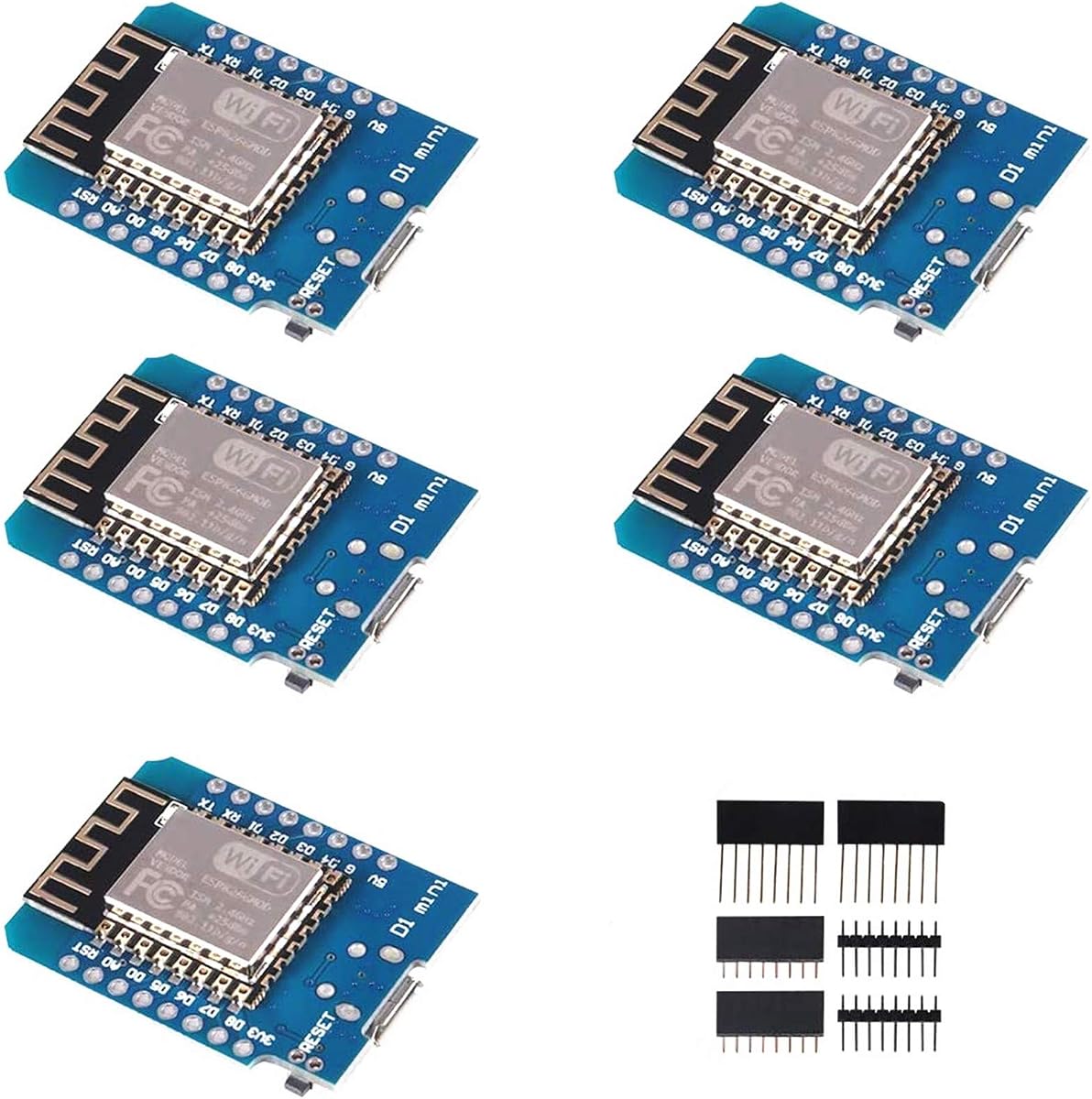
The 5pcs ESP8266 ESP-12 NodeMcu Mini D1 Module pack offers a more user-friendly alternative to the ESP-01 series. Rated at 4.5 stars, these boards feature 11 digital input/output pins and a built-in Micro USB connection, which simplifies the coding process. They are based on the ESP-8266EX and come with 4M Bytes of flash storage, making them suitable for a wide range of development tasks.
We may earn a commission when you buy through this link, at no additional cost to you.
One of the biggest benefits is the full access to GPIO pins and the integrated power regulation. Unlike the ESP-01, these modules do not require external breakout boards for most standard prototyping. The Micro USB port allows for direct connection to a computer for power and programming. The on-board 5V switching power supply ensures that the module operates safely within the required voltage range without extra components.
These modules are larger than the ESP-01, which might not fit in extremely tight spaces. However, the trade-off is well worth it for the ease of use and accessibility of pins. This makes them ideal for prototyping and educational projects where simplicity and flexibility are key. The Lua programming support also adds value for those who prefer scripting languages over C++ for embedded development.
We recommend this pack for beginners or anyone needing a plug-and-play WiFi module with full GPIO access. Whether you are building smart home devices or learning IoT development, these modules provide a stable and easy-to-use platform. The inclusion of USB connectivity makes the development loop much faster and more convenient than bare modules.
Micro USB connectivity allows you to upload code and power the board using a single standard cable.
Access to 11 digital pins enables more complex projects without needing to multiplex or add breakout boards.
We may earn a commission when you buy through this link, at no additional cost to you.
The 10-Pack ESP8266 ESP-01 Serial WiFi Transceiver Module provides the ultimate bulk option for developers planning large-scale networks. With a perfect 5.0-star rating, users appreciate the robust on-board processing and ample storage these modules offer. They are designed for seamless data retention and retrieval, making them ideal for applications requiring consistent performance and data logging capabilities over time.
We may earn a commission when you buy through this link, at no additional cost to you.
The sheer number of modules in this pack makes it perfect for testing multiple configurations or deploying sensors across a wide area. The modules support three distinct WiFi operation modes, providing versatile networking options for diverse application scenarios. The built-in LWIP TCP stack simplifies development by handling network protocols efficiently, ensuring smooth communication between your device and other nodes.
While the pack is excellent for bulk needs, it may be overkill for small individual projects. Users must have the technical knowledge to configure and solder these modules as they do not come with breakout boards. The quantity also means you will need space to store and manage the units. However, for professional prototyping or commercial deployments, the value is unmatched.
We recommend this pack for businesses or serious hobbyists building large sensor networks or commercial IoT solutions. If you need a reliable supply of modules to support your infrastructure without worrying about running out, this is a smart investment. The high rating reflects the quality and performance consistency across the batch.
With ten units, you can easily scale your project from a single node to a full network of connected devices.
Ample storage and processing power ensure that data logging and retrieval tasks run smoothly without interruptions.
We may earn a commission when you buy through this link, at no additional cost to you.
Selecting the right WiFi module involves balancing connectivity features, processing power, and ease of use for your specific application.
Check whether the module supports Wi-Fi only or both Wi-Fi and Bluetooth. Modern projects often require Bluetooth for direct device pairing in addition to network connectivity.
Choose a module with Bluetooth support if your project interacts with mobile apps or requires short-range communication options.
Look at the microcontroller specs. Dual-core processors like the ESP32 or ESP32-S3 can handle complex tasks while maintaining network stability.
Opt for dual-core solutions if you need to run heavy logic alongside wireless communication to avoid performance bottlenecks.
Ensure your power supply matches the module's voltage requirements. Many modules require 3.3V, so using 5V directly can damage the circuit.
Verify the voltage range and include proper regulators in your design to protect the module and ensure long-term stability.
Storage size impacts how complex your code can be. Flash memory ranging from 1MB to 4MB affects how many features you can include.
Select a module with higher flash if you need to store configuration files or large libraries locally on the device.
The physical size of the module determines its suitability for compact designs. Smaller modules like the ESP-01 are great for wearables but limit pin access.
Choose a smaller module for space-constrained projects but be prepared to use breakout boards for easier wiring and prototyping.
Modules with built-in USB interfaces like USB-C or Micro USB simplify the coding process. Others require external FTDI adapters.
Prioritize modules with direct USB support if you want to reduce wiring complexity and improve the speed of uploading sketches.
Popular modules often have extensive documentation and community libraries. This can significantly speed up your development process.
Choose a platform with strong community backing to ensure you can find tutorials and support when you encounter issues.
Verify that the module supports the necessary network modes like Access Point and Station. This flexibility allows for different network topologies.
Select a module that supports multiple modes if you plan to create a mesh network or use the device as a hotspot.
To use your module effectively, start by installing the necessary board support packages in your Arduino IDE. Select the correct board model and set the appropriate upload speed for your specific module to ensure a stable connection during programming.
Ensure your power supply is stable and matches the voltage requirements of the module. Use a regulated 3.3V power source for ESP8266 and ESP32 modules to prevent damage or erratic behavior during operation.
Care for your modules by avoiding physical stress on the pins and keeping them in a dry environment. Periodically check for firmware updates from the manufacturer to maintain security and performance in your connected devices.
No, you should not power ESP8266 modules directly with 5V as they require 3.3V. Using a 5V source without a voltage regulator can permanently damage the module. Always use a logic level converter or a stable 3.3V regulator for safe operation.
The ESP32 offers a dual-core processor, Bluetooth connectivity, and higher clock speeds compared to the single-core ESP8266. It also has more GPIO pins and enhanced security features, making it better for complex projects while the ESP8266 remains a cost-effective option for basic tasks.
Since the ESP-01 does not have long headers, you will need to solder a header strip to the pins or use a dedicated breakout board. This makes it easier to plug into a breadboard and connects to the VCC, GND, TX, and RX pins for power and communication.
Most modules come with a built-in PCB antenna that works well for standard indoor ranges. If you need significantly more range, you can replace it with an external SMA antenna, but be sure the module supports this feature and the connector is compatible.
Yes, both ESP8266 and ESP32 modules are compatible with the Arduino IDE. You will need to install the specific board manager URL for your chosen chip to add support and select the correct board type before uploading your code.
Instability often results from poor power supply stability or interference from other electronics. Ensure your voltage regulator can provide enough current and move the module away from sources of interference like motors or other WiFi routers.
Many ESP32 boards and ESP8266 modules support Over-the-Air updates allowing you to upload code wirelessly. Check the specific library support for your chosen board to configure OTA functionality in your sketch for remote updates.
Battery life depends heavily on power settings and how often the module wakes up to transmit data. Using deep sleep modes can extend battery life significantly to months, whereas constant connectivity will drain power much faster.
In summary, the Arduino UNO R4 WiFi stands out for its dual-core power and advanced connectivity, while the ESP8266 and ESP32 modules offer affordable and versatile options for various project needs.
Prioritize your requirements such as processing power, memory, and connectivity features before making a choice. If you need simplicity, consider modules with built-in USB interfaces, and if you need bulk value, opt for the multi-pack versions.
Remember that prices and availability can change frequently, so double-check the current details on Amazon before purchasing. This ensures you get the best deal and the right product for your specific IoT or embedded development goals.