
Omada AX3000 Wireless Access Point
4.5Editor score
Free cloud management included
Ultra-fast WiFi 6 speeds
Five year warranty coverage
Compare top commercial wireless routers for business use including WiFi 6 and 7 models with security and management features for offices and enterprises.
Selecting the right commercial wireless router is critical for maintaining secure and reliable connectivity in modern business environments. These devices must handle multiple simultaneous connections while ensuring data protection and seamless network management across various operational scenarios.
We have evaluated leading models based on their performance capabilities, security protocols, and ease of deployment. Each product offers unique features tailored to different business sizes and technical requirements ensuring you find the optimal solution for your network infrastructure needs.
This guide details the strengths and limitations of each router to help you make an informed decision. Note that availability and pricing may fluctuate over time so always verify current details before finalizing your purchase for your organization.
4.5Editor score
4.2Editor score

4.6Editor score
The following table provides a side by side comparison of all ten commercial wireless routers evaluated in this guide highlighting their key specifications and capabilities.




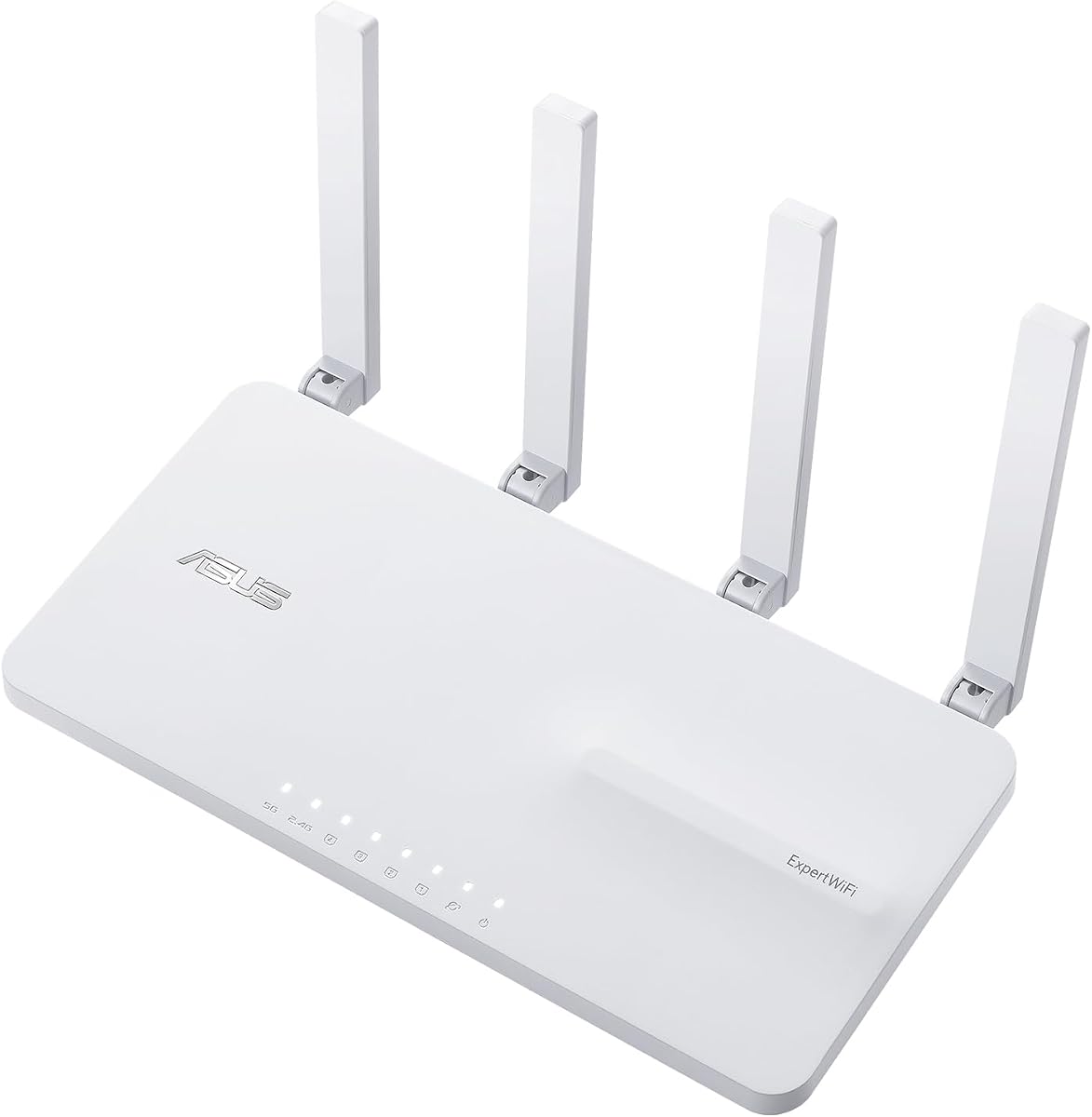
The ASUS ExpertWiFi EBR63 stands out as a top choice for small to medium businesses needing robust network control. It offers a rating of 4.2 stars from users who appreciate its ease of setup and remote management capabilities.
We may earn a commission when you buy through this link, at no additional cost to you.
Its standout qualities include customizable guest portals that allow you to tailor access experiences to match your brand. The router supports up to five SSIDs for device separation and includes free commercial grade security through AiProtection Pro.
While it excels in management and security, it lacks multiple high speed wired ports which might limit advanced setups. However, the USB port allows for backup WAN connectivity using a mobile hotspot ensuring stable internet during outages.
This router is ideal for businesses prioritizing security and ease of use over raw throughput. If you need scalable network management with strong protection features the EBR63 is a solid recommendation for your office.
Custom guest portals let you brand login pages and set access rules without extra hardware.
USB WAN backup ensures your network stays online even if your primary broadband connection fails.
We may earn a commission when you buy through this link, at no additional cost to you.
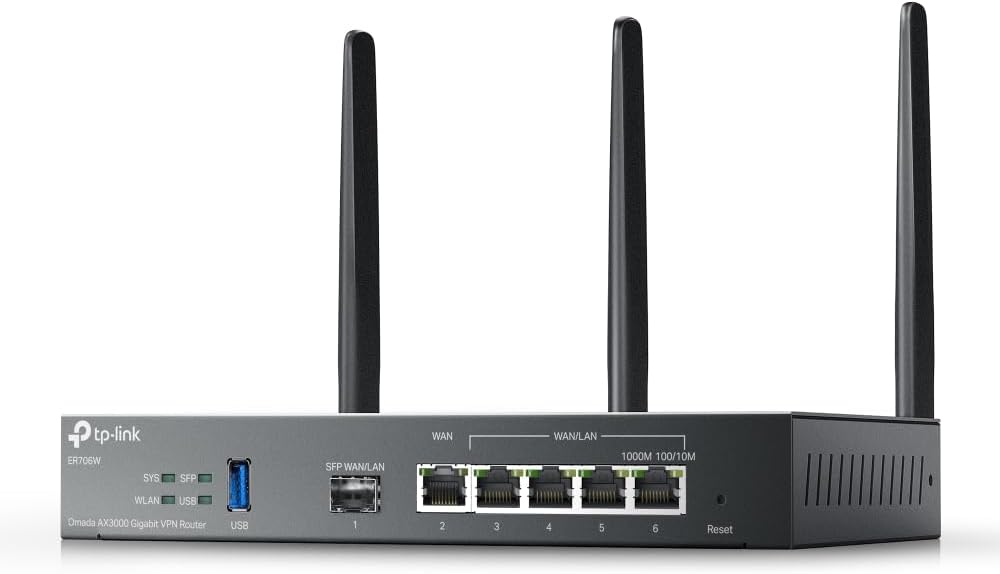
The Omada ER706W is designed for businesses requiring robust connectivity and flexibility. With a 4.1 star rating it delivers reliable performance for environments needing multiple internet lines and secure remote access.
We may earn a commission when you buy through this link, at no additional cost to you.
Key strengths include load balancing across up to five WAN ports which maximizes broadband utilization and redundancy. The router supports various VPN protocols including WireGuard and OpenVPN ensuring secure connections for remote workers.
On the downside setup may require more technical knowledge compared to consumer grade routers. Also while it supports WiFi 6 the speeds are limited compared to newer models but sufficient for standard office use.
This router is best for organizations needing resilient internet connections and advanced networking features. If you run a business with multiple ISPs the ER706W provides the stability you need.
Load balancing distributes traffic across multiple WAN ports to prevent slowdowns and outages.
Built-in VPN support allows secure connections for remote staff without additional gateway hardware.
We may earn a commission when you buy through this link, at no additional cost to you.
The Ruckus R750 is a specialized access point designed for ultra dense environments like conference rooms or stadiums. It holds a 4.3 star rating reflecting its ability to maintain high performance even with hundreds of devices connected.
We may earn a commission when you buy through this link, at no additional cost to you.
Its primary strength lies in handling high density connections without degradation. The unit is built for indoor deployment ensuring consistent coverage in challenging spaces where standard routers might struggle to maintain speed.
However this device typically requires a separate controller for management which adds to the initial cost and complexity. Also it is a single access point so large areas need multiple units deployed properly.
This access point is ideal for businesses with high client density in specific zones. If you need reliable WiFi in crowded meeting areas the R750 delivers the capacity you require.
Optimized for environments with hundreds of simultaneous users ensuring consistent bandwidth.
Designed specifically for indoor use to provide stable connections in complex building layouts.
We may earn a commission when you buy through this link, at no additional cost to you.
The Ruckus R670 brings next generation WiFi 7 technology to business deployments. With a 4.4 star rating it offers exceptional performance for environments ready to adopt the latest wireless standards.
We may earn a commission when you buy through this link, at no additional cost to you.
It features BeamFlex+ adaptive antenna technology which maximizes signal coverage and throughput by adapting to client needs. The combined data rate of 9.34 Gbps ensures ultra fast speeds for demanding applications.
The cost is higher than previous gen options and full benefits require compatible WiFi 7 clients. However the multi gigabit Ethernet port future proofs your network for faster wired backhaul connections.
This access point is perfect for businesses preparing for high bandwidth needs like video production or VR. If you want cutting edge WiFi performance the R670 is a top choice.
BeamFlex+ technology directs signal beams for better coverage and fewer connection errors.
Built-in 5 GbE port prevents wired bottlenecks for high speed WiFi 7 performance.
We may earn a commission when you buy through this link, at no additional cost to you.
The NETGEAR Orbi 970 is a flagship WiFi 7 mesh system built for large scale coverage. It boasts a 4.6 star rating for delivering seamless connectivity across spaces up to 10000 square feet with zero dead zones.
We may earn a commission when you buy through this link, at no additional cost to you.
Its exclusive quad-band technology reserves a dedicated lane for satellite traffic ensuring fast speeds on all devices simultaneously. The system supports up to 200 devices and includes 10 Gigabit ports for ultra-fast wired connections.
While the price is premium the value lies in extensive coverage and future proof performance. Setup is straightforward via the Orbi app though the hardware units are physically large and require proper placement.
This system is best for large campuses or multi-floor offices needing uniform high speed WiFi. If you want top tier performance with minimal management the Orbi 970 is unmatched.
Quad-band design keeps satellite traffic separate from client data for consistent speeds.
10 Gig ports allow NAS and gaming PCs to connect at maximum available bandwidth.
We may earn a commission when you buy through this link, at no additional cost to you.
The Omada EAP650 is an affordable access point that does not compromise on essential business features. With a 4.5 star rating it delivers ultra-fast WiFi 6 speeds and easy installation for various commercial settings.
We may earn a commission when you buy through this link, at no additional cost to you.
Its standout feature is free cloud management which removes the need for expensive hardware controllers. The device supports multiple power options including PoE making ceiling installation simple without extra power outlets.
While it is a single unit the slim design blends well into modern offices and hotels. The five year warranty provides long term peace of mind for organizations planning stable deployments.
This access point is ideal for small businesses needing reliable WiFi without high costs. If you want professional grade features at a budget price the EAP650 is a great pick.
Free cloud control avoids expensive controller hardware and simplifies multi-site management.
PoE and DC power options mean you can install anywhere without worrying about power sources.
We may earn a commission when you buy through this link, at no additional cost to you.
The Ubiquiti U6+ is a dual band access point designed for businesses already using UniFi infrastructure. It carries a 4.6 star rating for reliable wireless transmission speeds up to 3 Gbit/s and easy integration.
We may earn a commission when you buy through this link, at no additional cost to you.
Its high speed data transfer ensures efficient communication for clients. The unit supports PoE+ allowing power and data over one cable simplifying installation in remote locations.
Setup requires a UniFi controller which might be extra for non ecosystem users. Also it uses dual band rather than tri-band which is sufficient for standard business but not high density.
This access point is best for offices already invested in Ubiquiti gear. If you need reliable and fast connections within that ecosystem the U6+ is a solid choice.
Integrates seamlessly with UniFi switches and gateways for a single network interface.
3 Gbit/s throughput ensures fast file transfers and video calls without lag.
We may earn a commission when you buy through this link, at no additional cost to you.
The TP-Link BE6500 brings WiFi 7 technology to businesses at a competitive price. With a 4.3 star rating it supports Multi-Link Operation for enhanced throughput and lower latency across frequency bands.
We may earn a commission when you buy through this link, at no additional cost to you.
It achieves speeds up to 5.76 Gbps which is excellent for 4K streaming and VR gaming. The device integrates with multi-gig modems and includes secure by design features mandated by security agencies.
Wire ports include one 2.5 Gbps WAN and three 1 Gbps LAN ports limiting high speed wired connections. Management is simple via app which is good for quick setup but lacks deep controls.
This router is perfect for businesses wanting WiFi 7 without premium costs. If you need fast wireless speeds and basic wired needs the BE6500 is a smart pick.
MLO technology transfers data across multiple bands simultaneously for reduced latency.
2.5 Gbps ports allow connection to faster modems for next gen internet plans.
We may earn a commission when you buy through this link, at no additional cost to you.
The NETGEAR Nighthawk WiFi 7 is a dedicated tri-band router built to handle demanding home and office networks. It holds a 4.3 star rating for speeds up to 9.3 Gbps and reliable connectivity.
We may earn a commission when you buy through this link, at no additional cost to you.
Its standout feature is the 6 GHz band giving fastest devices their own lane to avoid slowdowns. The router supports up to 100 devices and includes 2.5 Gig ports for multi-gig wired connections.
Coverage is up to 2500 square feet which may be less than mesh options for large spaces. You also need a separate modem which is standard but worth noting for setup.
This router is ideal for offices needing high speeds in moderate sized areas. If you want fast WiFi and multi-gig support the Nighthawk is a strong contender.
Dedicated 6 GHz band reduces congestion for faster connections on compatible devices.
2.5 Gig ports unlock full potential of high-speed internet plans for faster downloads.
We may earn a commission when you buy through this link, at no additional cost to you.
The ASUS RT-BE88U combines blazing fast WiFi 7 with advanced wired connectivity. With a 4.3 star rating it delivers up to 7.2 Gbps wireless throughput and robust multi-gigabit support.
We may earn a commission when you buy through this link, at no additional cost to you.
It features two 10G ports one SFP+ and one WAN/LAN allowing massive wired capacity for servers and storage. AI WAN detection ensures always-on internet through versatile configuration and 4G LTE tethering.
Power usage is higher due to the quad-core 2.6GHz CPU which drives performance but increases heat. The AiMesh compatibility lets you expand coverage easily without replacing the router.
This router is best for offices needing high speed wired and wireless performance. If you want top connectivity with flexible expansion the RT-BE88U is a top option.
Dual 10G ports enable massive data transfers without network bottlenecks.
AI WAN detection automatically switches to mobile backup to keep business running.
We may earn a commission when you buy through this link, at no additional cost to you.
Selecting a commercial wireless router requires evaluating several technical factors to ensure your network meets business demands securely and efficiently.
WiFi 6 and WiFi 7 routers offer significant speed and capacity improvements over older standards. WiFi 7 supports Multi-Link Operation and 4K-QAM for lower latency and higher throughput which is essential for video conferencing and large file transfers.
Choose the latest standard if your budget allows to future proof your network against growing bandwidth demands.
Determine the square footage and number of concurrent devices your router must support. Mesh systems are better for large buildings while single access points suffice for smaller offices.
Look for routers that specify maximum device limits and coverage ratings to ensure reliable connections in all work zones.
Commercial routers must include advanced security like WPA3 encryption VPN support and threat protection. Some models come with free subscriptions to antivirus and firewall services to safeguard sensitive business data.
Prioritize devices with built-in protection to reduce reliance on additional security hardware.
Ease of management is crucial for small IT teams. Cloud-based management allows remote configuration and monitoring from any location without physical access to the hardware.
Check if the router supports centralized controllers or mobile apps for streamlined setup and updates.
Even in wireless networks wired ports remain vital for devices like NAS drives and printers. Look for multiple Gigabit ports and preferably 2.5G or 10G options for high-speed backhaul.
Ensure the router has enough LAN ports to avoid needing extra switches for essential wired devices.
As your business grows your network should expand easily. Routers compatible with mesh systems allow adding nodes without replacing the main unit.
Select a model that supports seamless roaming and easy addition of access points for growing needs.
Business continuity depends on internet reliability. Some routers offer multiple WAN ports or USB backup for cellular connections if primary internet fails.
Evaluate models with redundant internet support to minimize downtime during outages.
Commercial equipment should come with solid warranty coverage and technical support. Look for at least a three to five year warranty to protect your investment.
Verify support availability hours to ensure help is accessible during business critical issues.
Begin by placing the router in a central elevated location away from obstructions and electronics like microwaves. Proper placement ensures optimal signal distribution throughout your office space.
Update the firmware immediately after setup using the manufacturer's app or web interface. Regular updates patch security vulnerabilities and improve performance over time.
Monitor connected devices periodically and disable unused access points to save bandwidth. Clearing out old devices prevents clutter and potential security risks on your network.
Commercial routers typically offer advanced features like multiple SSIDs VLAN support and enhanced security protocols. They are built to handle higher device densities and include management tools for larger networks.
Yes most commercial routers require a separate modem to connect to your internet service provider. The router distributes the internet connection wirelessly while the modem handles the external line.
Yes using mesh compatible routers or access points allows you to expand coverage seamlessly. This setup provides consistent speeds and avoids dead zones across multiple floors or rooms.
Look for WPA3 encryption built-in firewalls and VPN support to secure data transmission. Some models include threat protection subscriptions that scan for malware and intrusion attempts.
You should update firmware whenever the manufacturer releases new versions or security patches. Enabling automatic updates ensures your router stays protected without manual intervention.
WiFi 7 is beneficial if your business relies on high bandwidth apps like VR or 4K streaming. For standard office tasks WiFi 6 offers sufficient speed at a lower cost.
We reviewed ten top commercial routers ranging from budget access points to premium WiFi 7 mesh systems. The ASUS ExpertWiFi EBR63 stands out for balanced features while the Omada EAP650 offers great value for small setups.
Prioritize security and management features that align with your team size and technical expertise. Ensure your chosen model supports enough devices and coverage area for current and future needs.
Always verify current pricing and availability as market conditions change. Choosing the right router now will save costs and ensure smooth operations as your business grows.